Research collection · 2026
Complete Baseball Research Portfolio
The complete 26-page collection, including the project index and all four research documents. Original bookmarks are retained.
October 2026 edition
Independent public-information research. Individual project limitations and provisional status remain applicable.
The original PDF and the pages below are hosted directly on this website. If your browser does not display the embedded document, open the original PDF or use the page-by-page reader.



Read document text (accessible alternative)
Text extracted from the original PDF. Tables may lose alignment; consult the original for layout.
Page 1
NOAH HEMPEL   /   INDEPENDENT BASEBALL RESEARCH
Selected Baseball Research | Project Index
BASEBALL OPERATIONS RESEARCH PORTFOLIO   |   OCTOBER 2026
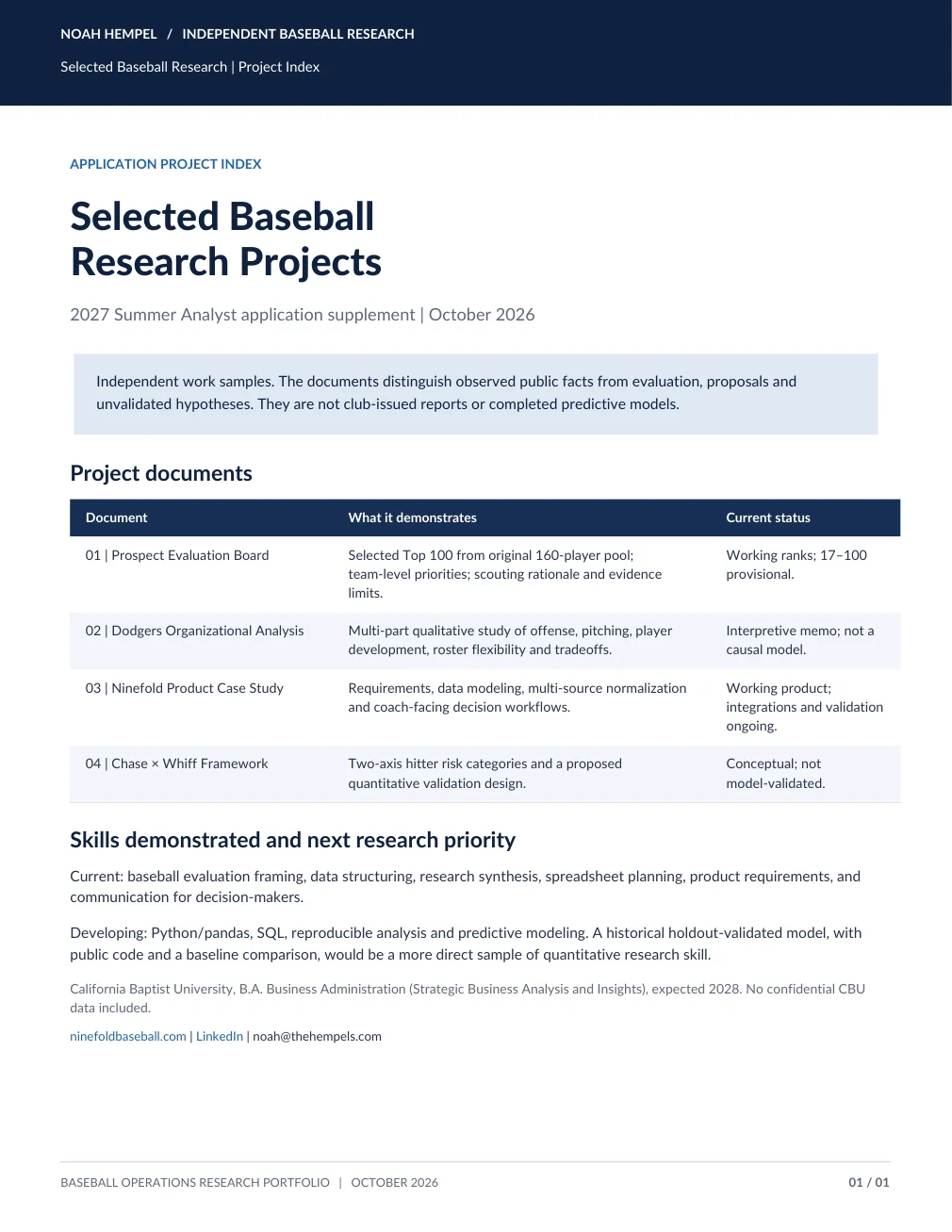
APPLICATION PROJECT INDEX
Selected Baseball
Research Projects
2027 Summer Analyst application supplement | October 2026
Independent work samples. The documents distinguish observed public facts from evaluation, proposals and
unvalidated hypotheses. They are not club-issued reports or completed predictive models.
Project documents
Document
What it demonstrates
Current status
01 | Prospect Evaluation Board
Selected Top 100 from original 160-player pool;
team-level priorities; scouting rationale and evidence
limits.
Working ranks; 17–100
provisional.
02 | Dodgers Organizational Analysis
Multi-part qualitative study of offense, pitching, player
development, roster flexibility and tradeoffs.
Interpretive memo; not a
causal model.
03 | Ninefold Product Case Study
Requirements, data modeling, multi-source normalization
and coach-facing decision workflows.
Working product;
integrations and validation
ongoing.
04 | Chase × Whiff Framework
Two-axis hitter risk categories and a proposed
quantitative validation design.
Conceptual; not
model-validated.
Skills demonstrated and next research priority
Current: baseball evaluation framing, data structuring, research synthesis, spreadsheet planning, product requirements, and
communication for decision-makers.
Developing: Python/pandas, SQL, reproducible analysis and predictive modeling. A historical holdout-validated model, with
public code and a baseline comparison, would be a more direct sample of quantitative research skill.
California Baptist University, B.A. Business Administration (Strategic Business Analysis and Insights), expected 2028. No confidential CBU
data included.
ninefoldbaseball.com | LinkedIn | noah@thehempels.com
01 / 01
Page 2
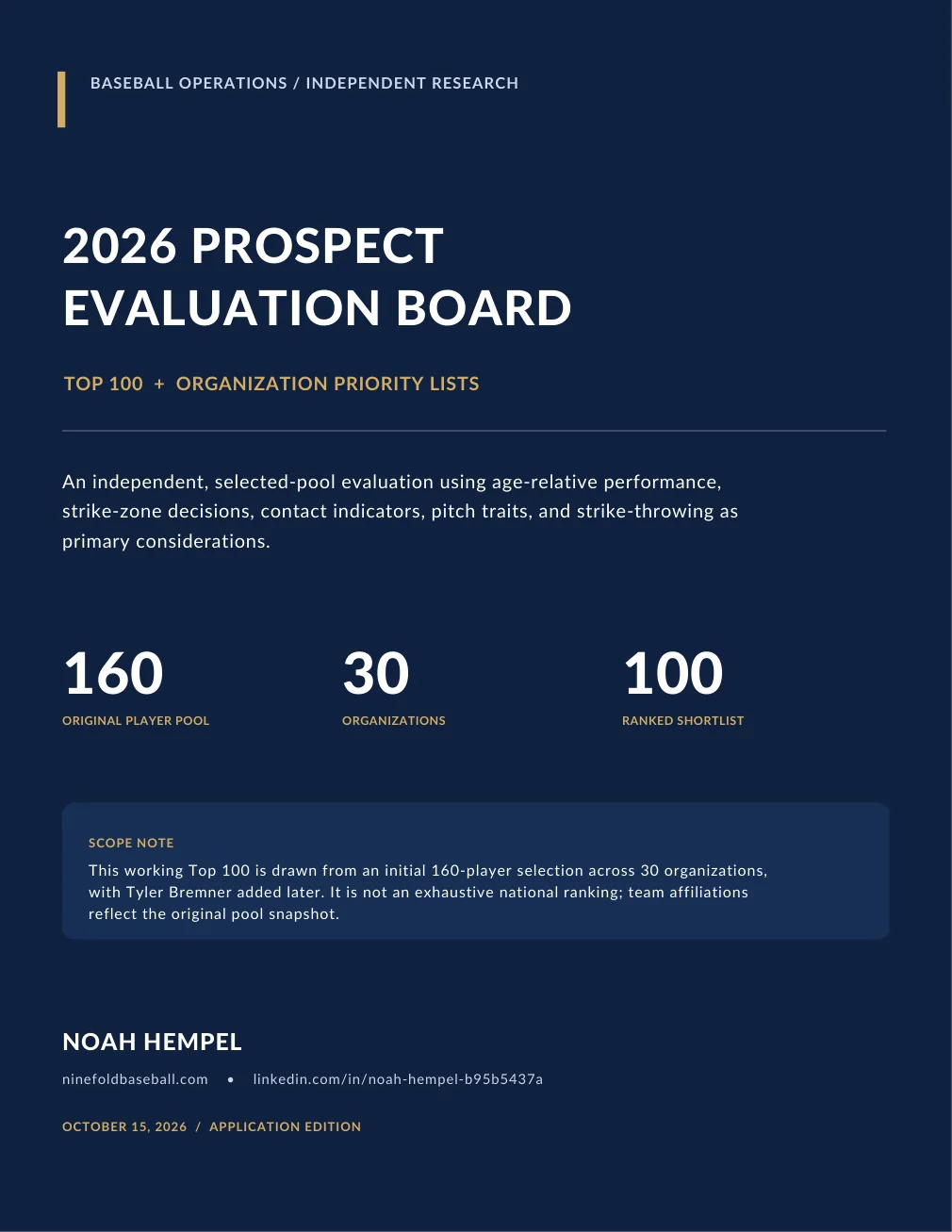
BASEBALL OPERATIONS / INDEPENDENT RESEARCH
2026 PROSPECT
EVALUATION BOARD
TOP 100  +  ORGANIZATION PRIORITY LISTS
An independent, selected-pool evaluation using age-relative performance,
strike-zone decisions, contact indicators, pitch traits, and strike-throwing as
primary considerations.
160
ORIGINAL PLAYER POOL
30
ORGANIZATIONS
100
RANKED SHORTLIST
SCOPE NOTE
This working Top 100 is drawn from an initial 160-player selection across 30 organizations,
with Tyler Bremner added later. It is not an exhaustive national ranking; team affiliations
reflect the original pool snapshot.
NOAH HEMPEL
ninefoldbaseball.com    •    linkedin.com/in/noah-hempel-b95b5437a
OCTOBER 15, 2026  /  APPLICATION EDITION
Page 3
NOAH HEMPEL  /  INDEPENDENT BASEBALL RESEARCH
Methodology & evidence standard
01
Ranking criteria, evidence hierarchy, and remaining uncertainty
2026 PROSPECT EVALUATION BOARD  •  SELECTED POOL
02
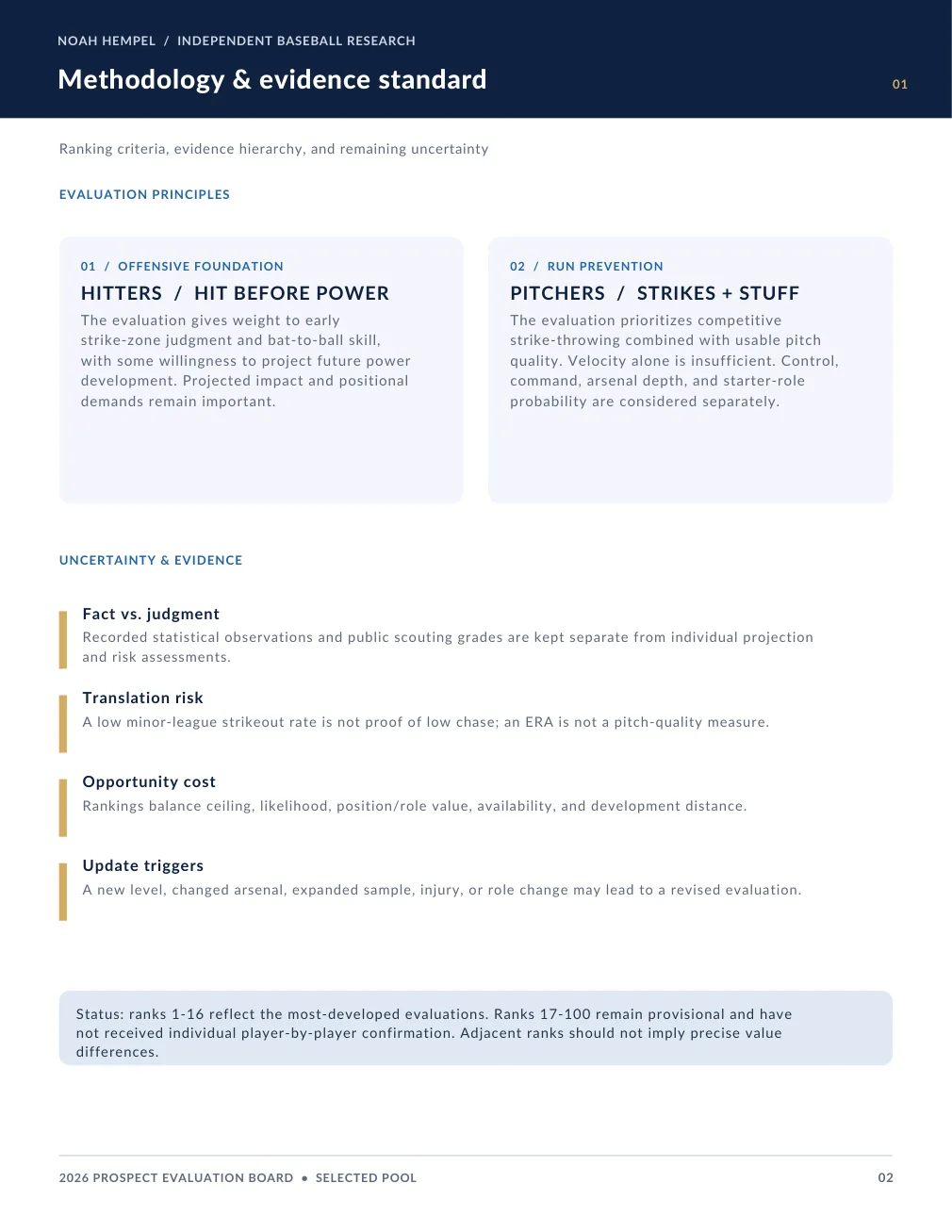
EVALUATION PRINCIPLES
01  /  OFFENSIVE FOUNDATION
HITTERS  /  HIT BEFORE POWER
The evaluation gives weight to early
strike-zone judgment and bat-to-ball skill,
with some willingness to project future power
development. Projected impact and positional
demands remain important.
02  /  RUN PREVENTION
PITCHERS  /  STRIKES + STUFF
The evaluation prioritizes competitive
strike-throwing combined with usable pitch
quality. Velocity alone is insufficient. Control,
command, arsenal depth, and starter-role
probability are considered separately.
UNCERTAINTY & EVIDENCE
Fact vs. judgment
Recorded statistical observations and public scouting grades are kept separate from individual projection
and risk assessments.
Translation risk
A low minor-league strikeout rate is not proof of low chase; an ERA is not a pitch-quality measure.
Opportunity cost
Rankings balance ceiling, likelihood, position/role value, availability, and development distance.
Update triggers
A new level, changed arsenal, expanded sample, injury, or role change may lead to a revised evaluation.
Status: ranks 1-16 reflect the most-developed evaluations. Ranks 17-100 remain provisional and have
not received individual player-by-player confirmation. Adjacent ranks should not imply precise value
differences.
Page 4
NOAH HEMPEL  /  INDEPENDENT BASEBALL RESEARCH
Highest-priority evaluations
02
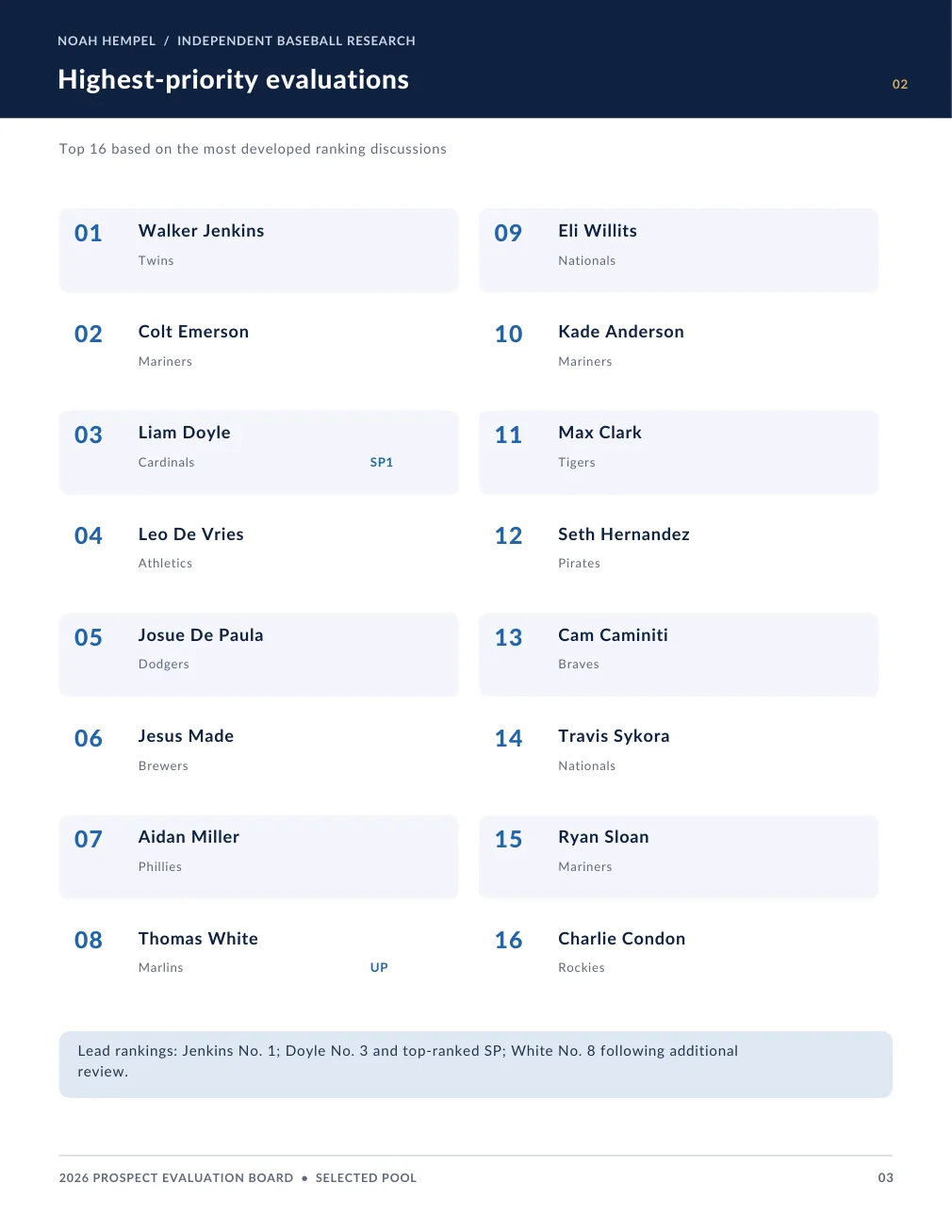
Top 16 based on the most developed ranking discussions
2026 PROSPECT EVALUATION BOARD  •  SELECTED POOL
03
01
Walker Jenkins
Twins
02
Colt Emerson
Mariners
03
Liam Doyle
Cardinals
SP1
04
Leo De Vries
Athletics
05
Josue De Paula
Dodgers
06
Jesus Made
Brewers
07
Aidan Miller
Phillies
08
Thomas White
Marlins
UP
09
Eli Willits
Nationals
10
Kade Anderson
Mariners
11
Max Clark
Tigers
12
Seth Hernandez
Pirates
13
Cam Caminiti
Braves
14
Travis Sykora
Nationals
15
Ryan Sloan
Mariners
16
Charlie Condon
Rockies
Lead rankings: Jenkins No. 1; Doyle No. 3 and top-ranked SP; White No. 8 following additional
review.
Page 5
NOAH HEMPEL  /  INDEPENDENT BASEBALL RESEARCH
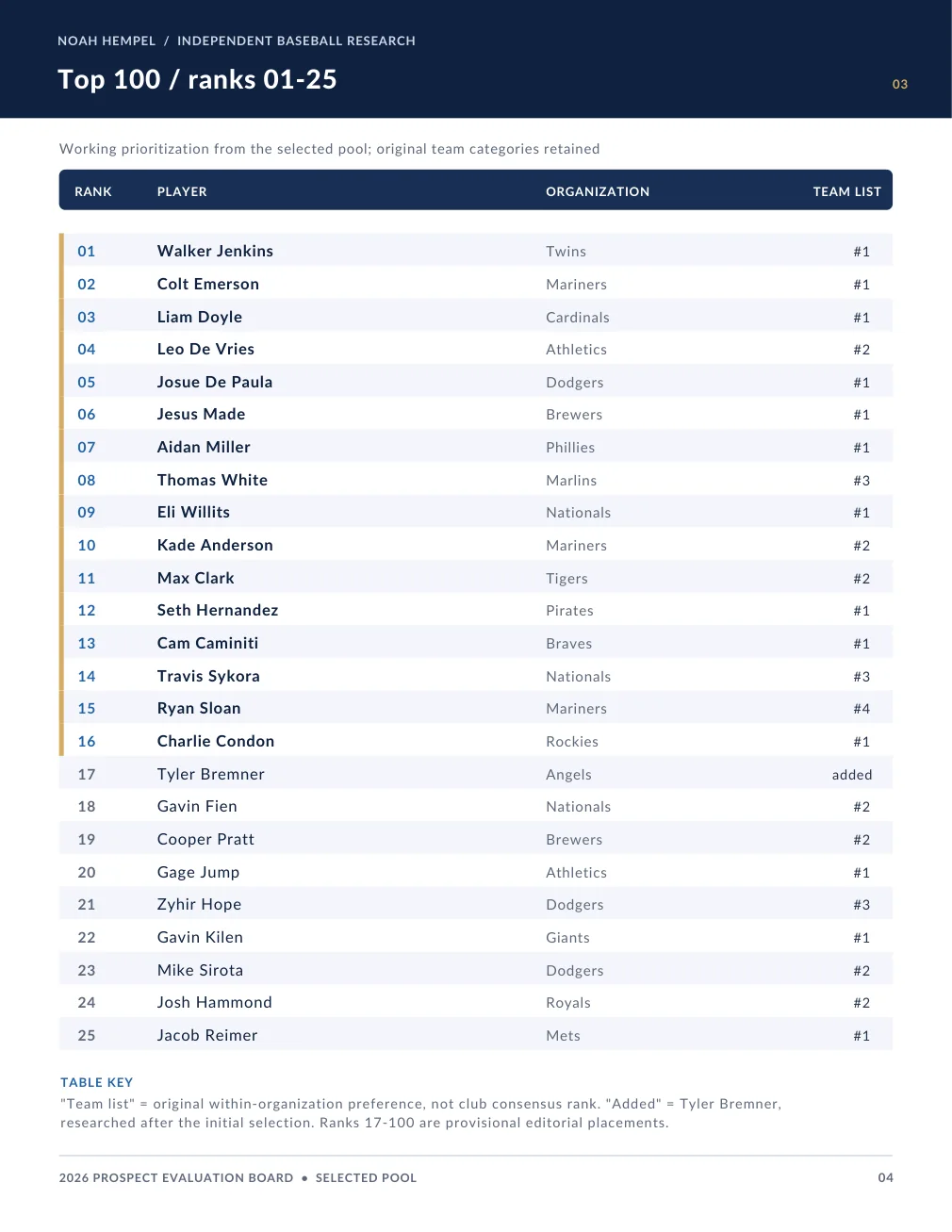
Top 100 / ranks 01-25
03
Working prioritization from the selected pool; original team categories retained
2026 PROSPECT EVALUATION BOARD  •  SELECTED POOL
04
RANK
PLAYER
ORGANIZATION
TEAM LIST
01
Walker Jenkins
Twins
#1
02
Colt Emerson
Mariners
#1
03
Liam Doyle
Cardinals
#1
04
Leo De Vries
Athletics
#2
05
Josue De Paula
Dodgers
#1
06
Jesus Made
Brewers
#1
07
Aidan Miller
Phillies
#1
08
Thomas White
Marlins
#3
09
Eli Willits
Nationals
#1
10
Kade Anderson
Mariners
#2
11
Max Clark
Tigers
#2
12
Seth Hernandez
Pirates
#1
13
Cam Caminiti
Braves
#1
14
Travis Sykora
Nationals
#3
15
Ryan Sloan
Mariners
#4
16
Charlie Condon
Rockies
#1
17
Tyler Bremner
Angels
added
18
Gavin Fien
Nationals
#2
19
Cooper Pratt
Brewers
#2
20
Gage Jump
Athletics
#1
21
Zyhir Hope
Dodgers
#3
22
Gavin Kilen
Giants
#1
23
Mike Sirota
Dodgers
#2
24
Josh Hammond
Royals
#2
25
Jacob Reimer
Mets
#1
TABLE KEY
"Team list" = original within-organization preference, not club consensus rank. "Added" = Tyler Bremner,
researched after the initial selection. Ranks 17-100 are provisional editorial placements.
Page 6
NOAH HEMPEL  /  INDEPENDENT BASEBALL RESEARCH
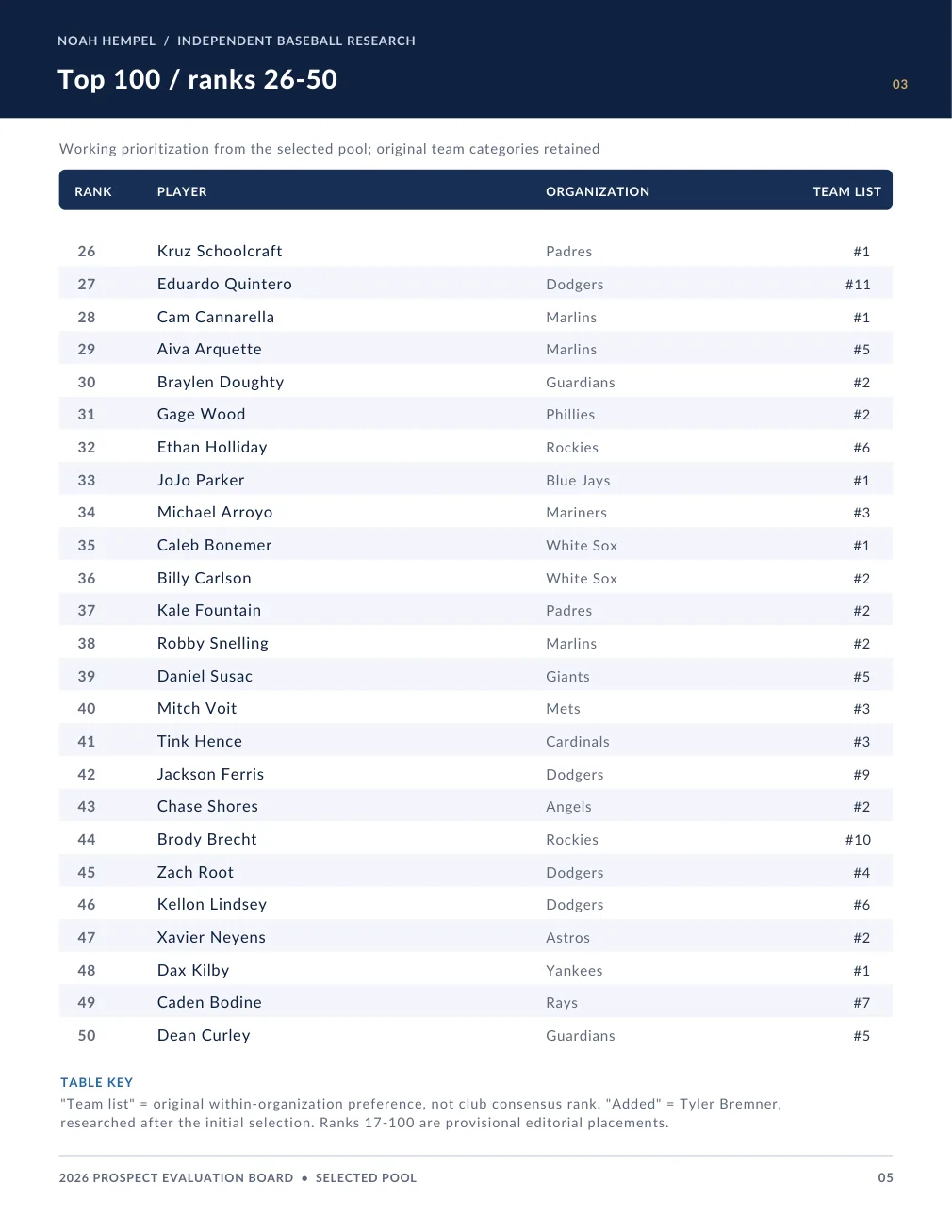
Top 100 / ranks 26-50
03
Working prioritization from the selected pool; original team categories retained
2026 PROSPECT EVALUATION BOARD  •  SELECTED POOL
05
RANK
PLAYER
ORGANIZATION
TEAM LIST
26
Kruz Schoolcraft
Padres
#1
27
Eduardo Quintero
Dodgers
#11
28
Cam Cannarella
Marlins
#1
29
Aiva Arquette
Marlins
#5
30
Braylen Doughty
Guardians
#2
31
Gage Wood
Phillies
#2
32
Ethan Holliday
Rockies
#6
33
JoJo Parker
Blue Jays
#1
34
Michael Arroyo
Mariners
#3
35
Caleb Bonemer
White Sox
#1
36
Billy Carlson
White Sox
#2
37
Kale Fountain
Padres
#2
38
Robby Snelling
Marlins
#2
39
Daniel Susac
Giants
#5
40
Mitch Voit
Mets
#3
41
Tink Hence
Cardinals
#3
42
Jackson Ferris
Dodgers
#9
43
Chase Shores
Angels
#2
44
Brody Brecht
Rockies
#10
45
Zach Root
Dodgers
#4
46
Kellon Lindsey
Dodgers
#6
47
Xavier Neyens
Astros
#2
48
Dax Kilby
Yankees
#1
49
Caden Bodine
Rays
#7
50
Dean Curley
Guardians
#5
TABLE KEY
"Team list" = original within-organization preference, not club consensus rank. "Added" = Tyler Bremner,
researched after the initial selection. Ranks 17-100 are provisional editorial placements.
Page 7
NOAH HEMPEL  /  INDEPENDENT BASEBALL RESEARCH
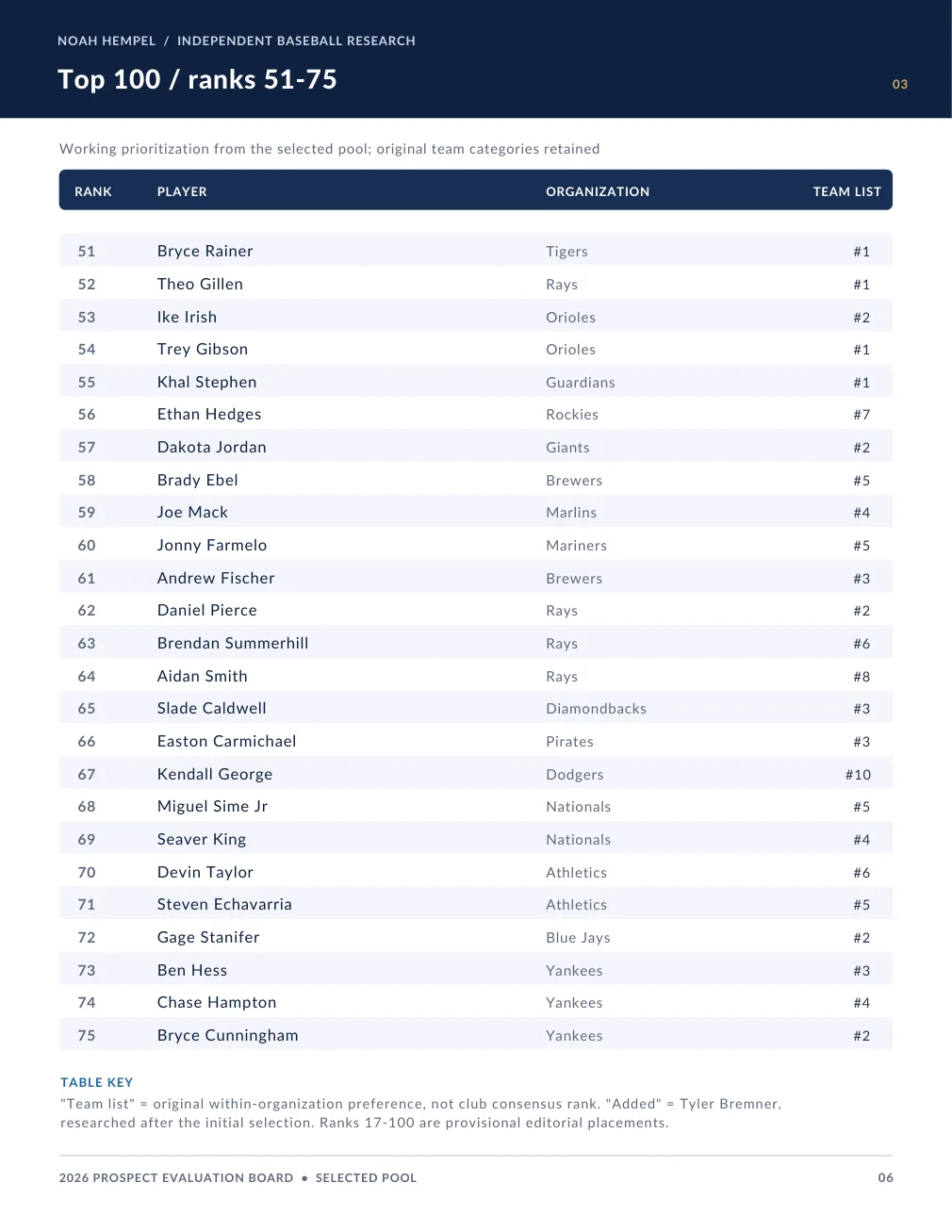
Top 100 / ranks 51-75
03
Working prioritization from the selected pool; original team categories retained
2026 PROSPECT EVALUATION BOARD  •  SELECTED POOL
06
RANK
PLAYER
ORGANIZATION
TEAM LIST
51
Bryce Rainer
Tigers
#1
52
Theo Gillen
Rays
#1
53
Ike Irish
Orioles
#2
54
Trey Gibson
Orioles
#1
55
Khal Stephen
Guardians
#1
56
Ethan Hedges
Rockies
#7
57
Dakota Jordan
Giants
#2
58
Brady Ebel
Brewers
#5
59
Joe Mack
Marlins
#4
60
Jonny Farmelo
Mariners
#5
61
Andrew Fischer
Brewers
#3
62
Daniel Pierce
Rays
#2
63
Brendan Summerhill
Rays
#6
64
Aidan Smith
Rays
#8
65
Slade Caldwell
Diamondbacks
#3
66
Easton Carmichael
Pirates
#3
67
Kendall George
Dodgers
#10
68
Miguel Sime Jr
Nationals
#5
69
Seaver King
Nationals
#4
70
Devin Taylor
Athletics
#6
71
Steven Echavarria
Athletics
#5
72
Gage Stanifer
Blue Jays
#2
73
Ben Hess
Yankees
#3
74
Chase Hampton
Yankees
#4
75
Bryce Cunningham
Yankees
#2
TABLE KEY
"Team list" = original within-organization preference, not club consensus rank. "Added" = Tyler Bremner,
researched after the initial selection. Ranks 17-100 are provisional editorial placements.
Page 8
NOAH HEMPEL  /  INDEPENDENT BASEBALL RESEARCH
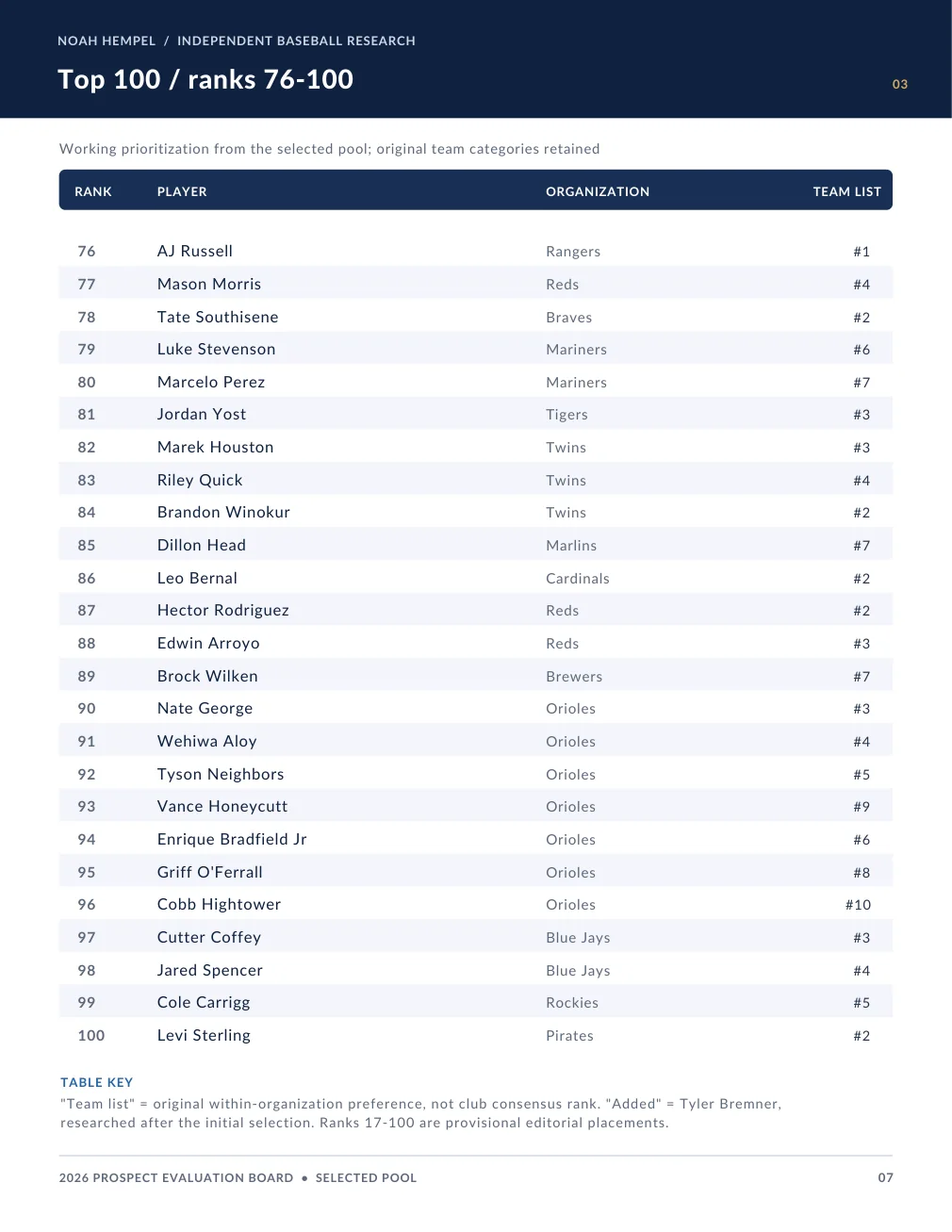
Top 100 / ranks 76-100
03
Working prioritization from the selected pool; original team categories retained
2026 PROSPECT EVALUATION BOARD  •  SELECTED POOL
07
RANK
PLAYER
ORGANIZATION
TEAM LIST
76
AJ Russell
Rangers
#1
77
Mason Morris
Reds
#4
78
Tate Southisene
Braves
#2
79
Luke Stevenson
Mariners
#6
80
Marcelo Perez
Mariners
#7
81
Jordan Yost
Tigers
#3
82
Marek Houston
Twins
#3
83
Riley Quick
Twins
#4
84
Brandon Winokur
Twins
#2
85
Dillon Head
Marlins
#7
86
Leo Bernal
Cardinals
#2
87
Hector Rodriguez
Reds
#2
88
Edwin Arroyo
Reds
#3
89
Brock Wilken
Brewers
#7
90
Nate George
Orioles
#3
91
Wehiwa Aloy
Orioles
#4
92
Tyson Neighbors
Orioles
#5
93
Vance Honeycutt
Orioles
#9
94
Enrique Bradfield Jr
Orioles
#6
95
Griff O'Ferrall
Orioles
#8
96
Cobb Hightower
Orioles
#10
97
Cutter Coffey
Blue Jays
#3
98
Jared Spencer
Blue Jays
#4
99
Cole Carrigg
Rockies
#5
100
Levi Sterling
Pirates
#2
TABLE KEY
"Team list" = original within-organization preference, not club consensus rank. "Added" = Tyler Bremner,
researched after the initial selection. Ranks 17-100 are provisional editorial placements.
Page 9
NOAH HEMPEL  /  INDEPENDENT BASEBALL RESEARCH
Selected hitter evaluations
04
Public observations and individual assessment distinguished
2026 PROSPECT EVALUATION BOARD  •  SELECTED POOL
08
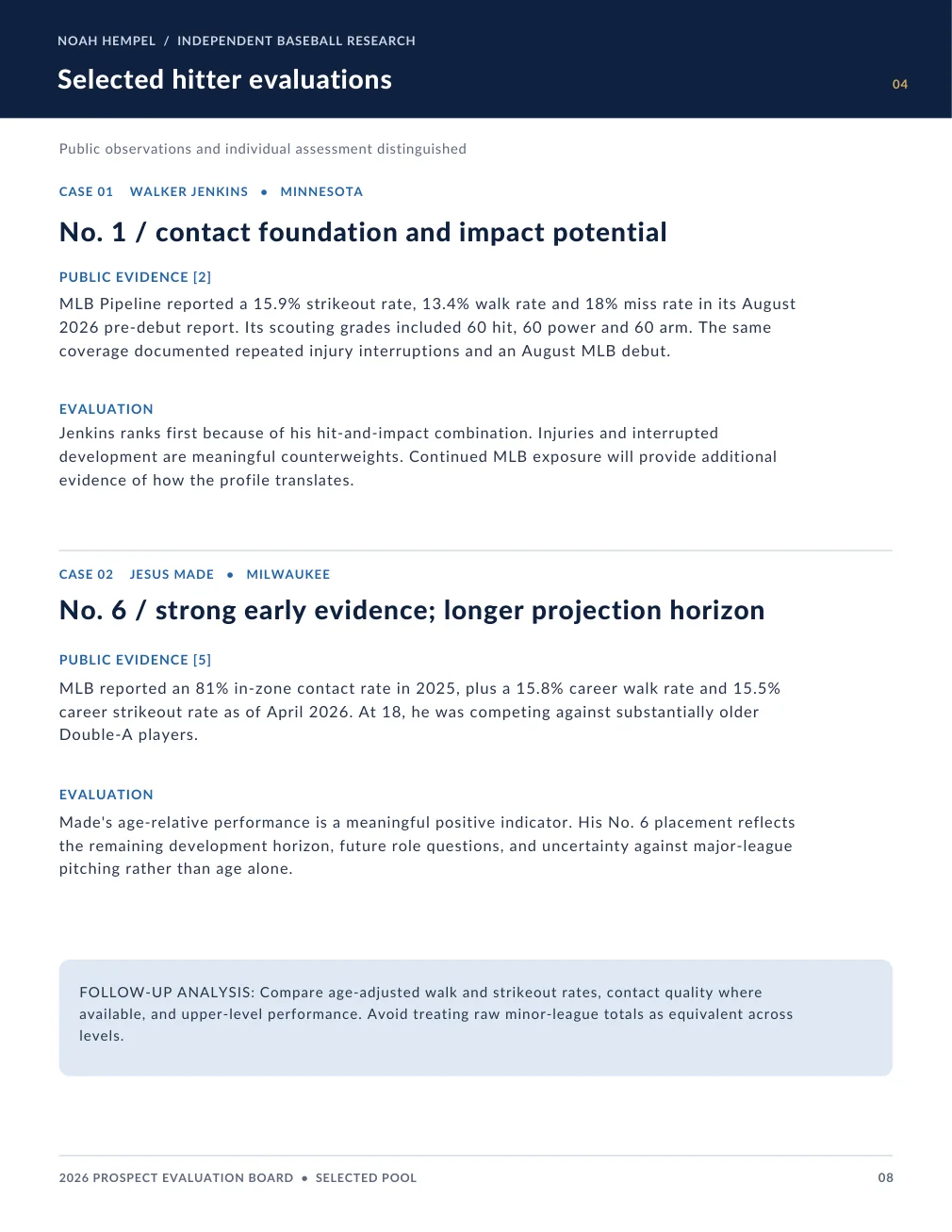
CASE 01    WALKER JENKINS   •   MINNESOTA
No. 1 / contact foundation and impact potential
PUBLIC EVIDENCE [2]
MLB Pipeline reported a 15.9% strikeout rate, 13.4% walk rate and 18% miss rate in its August
2026 pre-debut report. Its scouting grades included 60 hit, 60 power and 60 arm. The same
coverage documented repeated injury interruptions and an August MLB debut.
EVALUATION
Jenkins ranks first because of his hit-and-impact combination. Injuries and interrupted
development are meaningful counterweights. Continued MLB exposure will provide additional
evidence of how the profile translates.
CASE 02    JESUS MADE   •   MILWAUKEE
No. 6 / strong early evidence; longer projection horizon
PUBLIC EVIDENCE [5]
MLB reported an 81% in-zone contact rate in 2025, plus a 15.8% career walk rate and 15.5%
career strikeout rate as of April 2026. At 18, he was competing against substantially older
Double-A players.
EVALUATION
Made's age-relative performance is a meaningful positive indicator. His No. 6 placement reflects
the remaining development horizon, future role questions, and uncertainty against major-league
pitching rather than age alone.
FOLLOW-UP ANALYSIS: Compare age-adjusted walk and strikeout rates, contact quality where
available, and upper-level performance. Avoid treating raw minor-league totals as equivalent across
levels.
Page 10
NOAH HEMPEL  /  INDEPENDENT BASEBALL RESEARCH
Selected pitcher evaluations
05
Comparing pitch quality, strike-throwing, and starter probability
2026 PROSPECT EVALUATION BOARD  •  SELECTED POOL
09
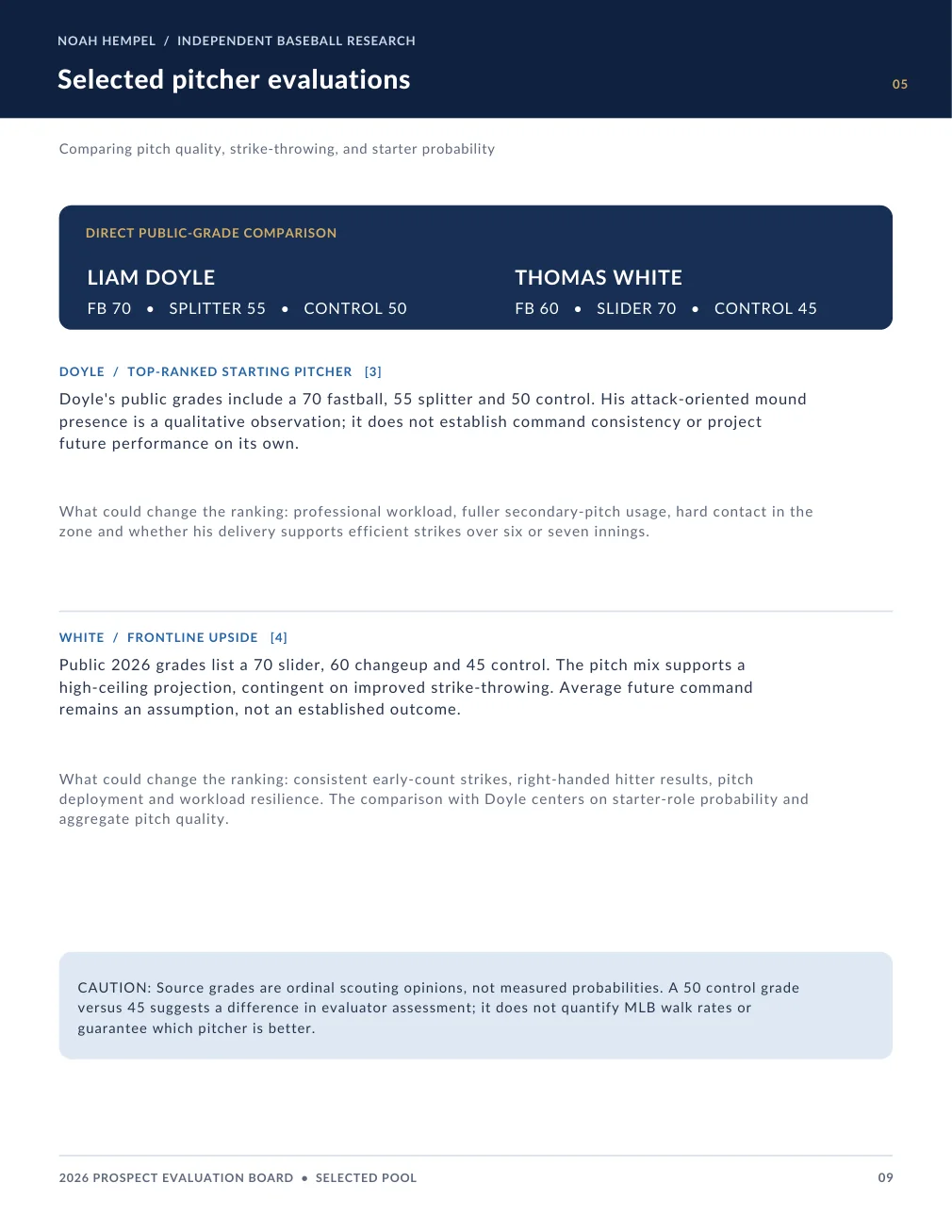
DIRECT PUBLIC-GRADE COMPARISON
LIAM DOYLE
FB 70   •   SPLITTER 55   •   CONTROL 50
THOMAS WHITE
FB 60   •   SLIDER 70   •   CONTROL 45
DOYLE  /  TOP-RANKED STARTING PITCHER   [3]
Doyle's public grades include a 70 fastball, 55 splitter and 50 control. His attack-oriented mound
presence is a qualitative observation; it does not establish command consistency or project
future performance on its own.
What could change the ranking: professional workload, fuller secondary-pitch usage, hard contact in the
zone and whether his delivery supports efficient strikes over six or seven innings.
WHITE  /  FRONTLINE UPSIDE   [4]
Public 2026 grades list a 70 slider, 60 changeup and 45 control. The pitch mix supports a
high-ceiling projection, contingent on improved strike-throwing. Average future command
remains an assumption, not an established outcome.
What could change the ranking: consistent early-count strikes, right-handed hitter results, pitch
deployment and workload resilience. The comparison with Doyle centers on starter-role probability and
aggregate pitch quality.
CAUTION: Source grades are ordinal scouting opinions, not measured probabilities. A 50 control grade
versus 45 suggests a difference in evaluator assessment; it does not quantify MLB walk rates or
guarantee which pitcher is better.
Page 11
NOAH HEMPEL  /  INDEPENDENT BASEBALL RESEARCH
Evaluation differences & follow-up
06
Areas for additional evidence and potential ranking changes
2026 PROSPECT EVALUATION BOARD  •  SELECTED POOL
10
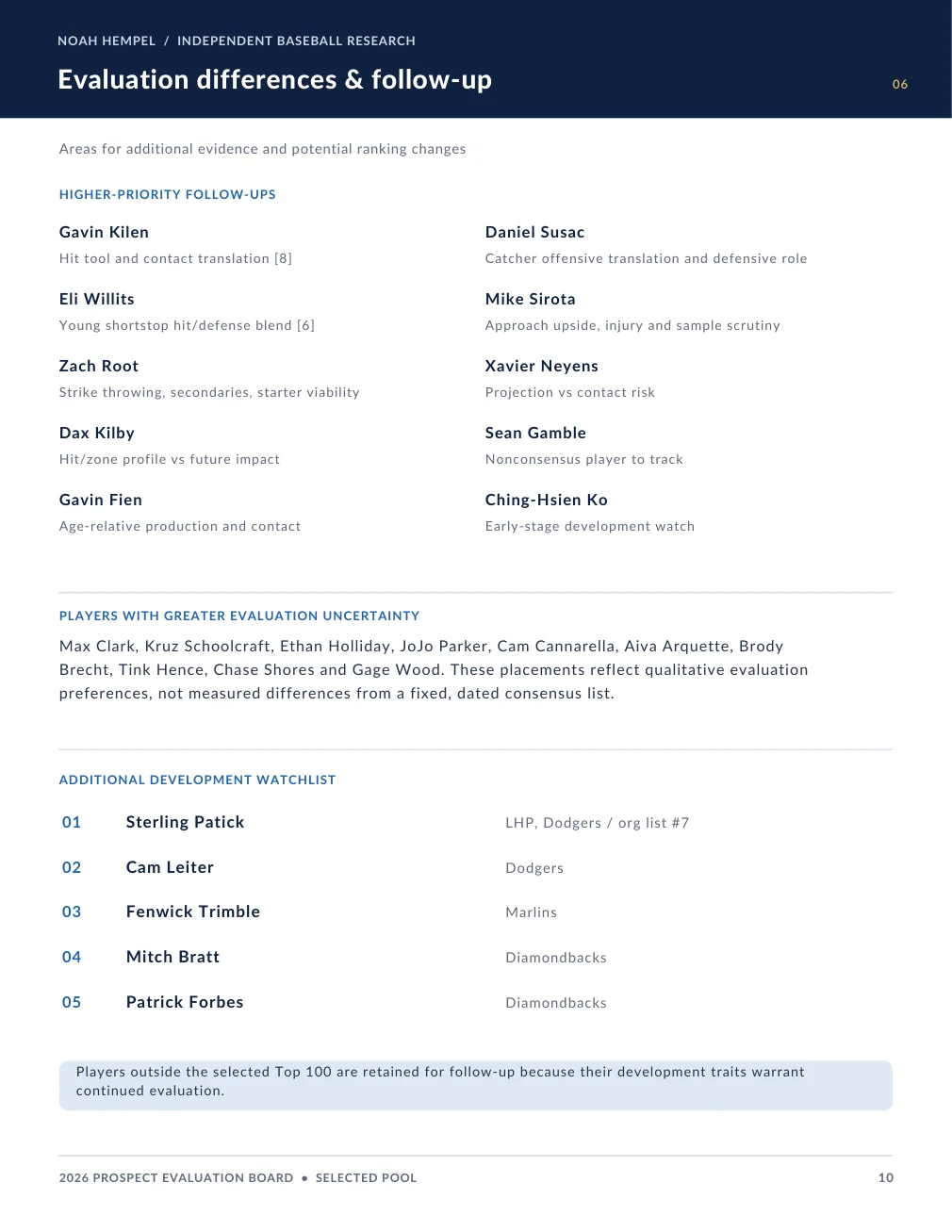
HIGHER-PRIORITY FOLLOW-UPS
Gavin Kilen
Hit tool and contact translation [8]
Eli Willits
Young shortstop hit/defense blend [6]
Zach Root
Strike throwing, secondaries, starter viability
Dax Kilby
Hit/zone profile vs future impact
Gavin Fien
Age-relative production and contact
Daniel Susac
Catcher offensive translation and defensive role
Mike Sirota
Approach upside, injury and sample scrutiny
Xavier Neyens
Projection vs contact risk
Sean Gamble
Nonconsensus player to track
Ching-Hsien Ko
Early-stage development watch
PLAYERS WITH GREATER EVALUATION UNCERTAINTY
Max Clark, Kruz Schoolcraft, Ethan Holliday, JoJo Parker, Cam Cannarella, Aiva Arquette, Brody
Brecht, Tink Hence, Chase Shores and Gage Wood. These placements reflect qualitative evaluation
preferences, not measured differences from a fixed, dated consensus list.
ADDITIONAL DEVELOPMENT WATCHLIST
01
Sterling Patick
LHP, Dodgers / org list #7
02
Cam Leiter
Dodgers
03
Fenwick Trimble
Marlins
04
Mitch Bratt
Diamondbacks
05
Patrick Forbes
Diamondbacks
Players outside the selected Top 100 are retained for follow-up because their development traits warrant
continued evaluation.
Page 12
NOAH HEMPEL  /  INDEPENDENT BASEBALL RESEARCH
Organization priority lists
07
Original pool organization grouping; selection rank shown where applicable
2026 PROSPECT EVALUATION BOARD  •  SELECTED POOL
11
DODGERS
11
01
Josue De Paula
#5
02
Mike Sirota
#23
03
Zyhir Hope
#21
04
Zach Root
#45
05
Ching-Hsien Ko
—
06
Kellon Lindsey
#46
07
Sterling Patick
—
08
Cam Leiter
—
09
Jackson Ferris
#42
10
Kendall George
#67
11
Eduardo Quintero
#27
DIAMONDBACKS
6
01
Brian Curley
—
02
Mitch Bratt
—
03
Slade Caldwell
#65
04
Tommy Troy
—
05
JD Dix
—
06
Patrick Forbes
—
PADRES
2
01
Kruz Schoolcraft
#26
02
Kale Fountain
#37
GIANTS
5
01
Gavin Kilen
#22
02
Dakota Jordan
#57
03
Bo Davidson
—
04
Jacob Bresnahan
—
05
Daniel Susac
#39
ROCKIES
10
01
Charlie Condon
#16
02
JB Middleton
—
03
Jared Thomas
—
04
Jackson Cox
—
05
Cole Carrigg
#99
06
Ethan Holliday
#32
07
Ethan Hedges
#56
08
Zac Veen
—
09
Roc Riggio
—
10
Brody Brecht
#44
CARDINALS
3
01
Liam Doyle
#3
02
Leo Bernal
#86
03
Tink Hence
#41
REDS
4
01
Steele Hall
—
02
Hector Rodriguez
#87
03
Edwin Arroyo
#88
04
Mason Morris
#77
PIRATES
4
01
Seth Hernandez
#12
02
Levi Sterling
#100
03
Easton Carmichael
#66
04
Wyatt Sanford
—
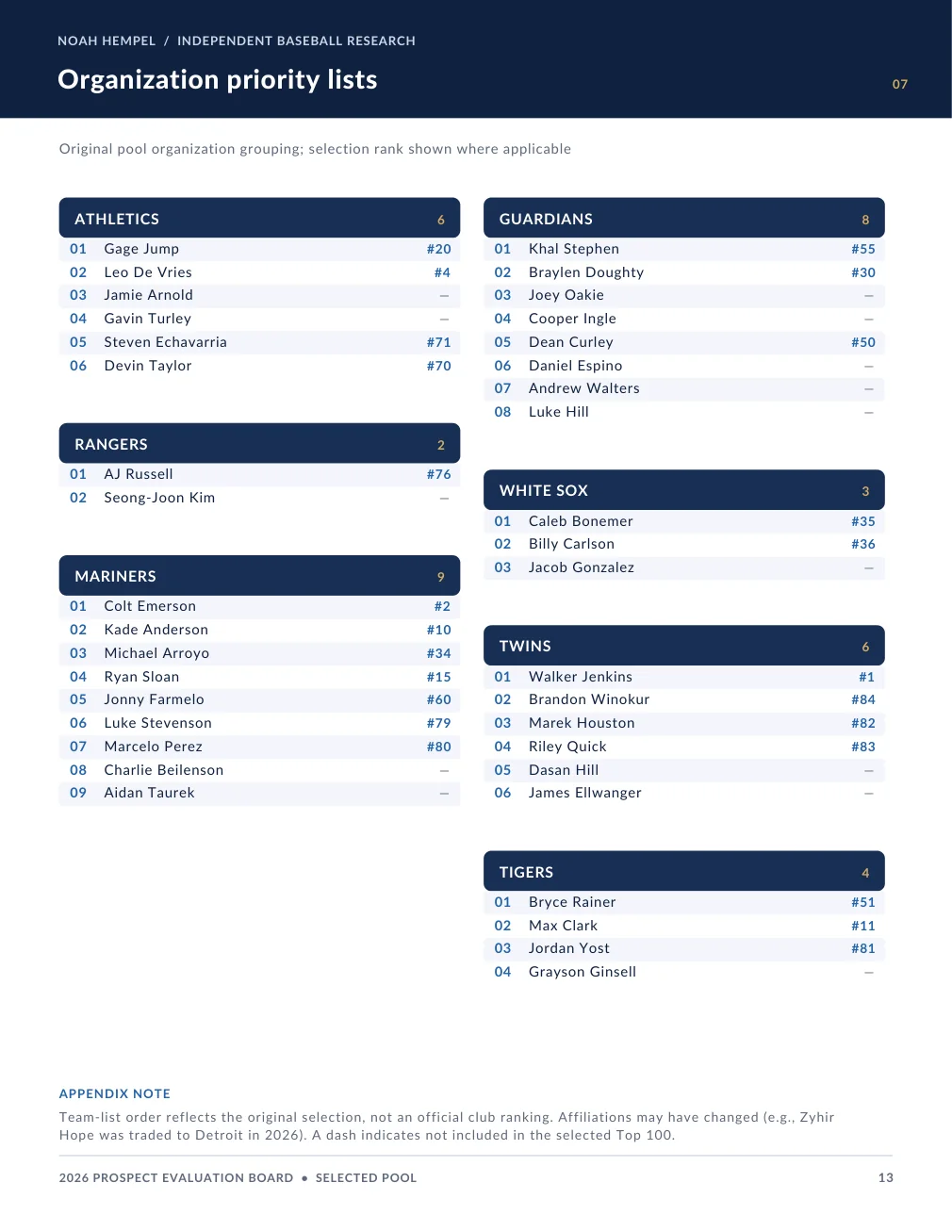
APPENDIX NOTE
Team-list order reflects the original selection, not an official club ranking. Affiliations may have changed (e.g., Zyhir
Hope was traded to Detroit in 2026). A dash indicates not included in the selected Top 100.
Page 13
NOAH HEMPEL  /  INDEPENDENT BASEBALL RESEARCH
Organization priority lists
07
Original pool organization grouping; selection rank shown where applicable
2026 PROSPECT EVALUATION BOARD  •  SELECTED POOL
12
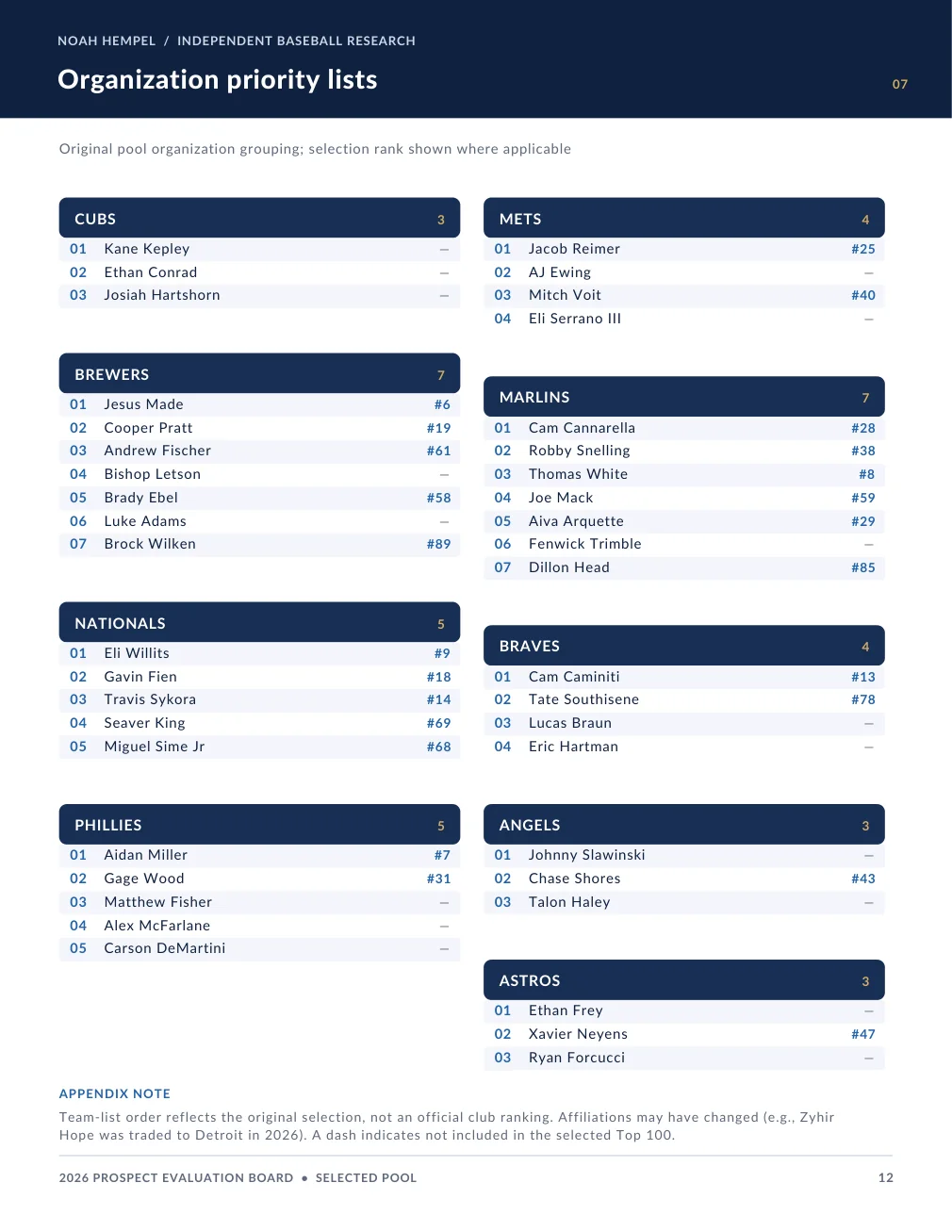
CUBS
3
01
Kane Kepley
—
02
Ethan Conrad
—
03
Josiah Hartshorn
—
BREWERS
7
01
Jesus Made
#6
02
Cooper Pratt
#19
03
Andrew Fischer
#61
04
Bishop Letson
—
05
Brady Ebel
#58
06
Luke Adams
—
07
Brock Wilken
#89
NATIONALS
5
01
Eli Willits
#9
02
Gavin Fien
#18
03
Travis Sykora
#14
04
Seaver King
#69
05
Miguel Sime Jr
#68
PHILLIES
5
01
Aidan Miller
#7
02
Gage Wood
#31
03
Matthew Fisher
—
04
Alex McFarlane
—
05
Carson DeMartini
—
METS
4
01
Jacob Reimer
#25
02
AJ Ewing
—
03
Mitch Voit
#40
04
Eli Serrano III
—
MARLINS
7
01
Cam Cannarella
#28
02
Robby Snelling
#38
03
Thomas White
#8
04
Joe Mack
#59
05
Aiva Arquette
#29
06
Fenwick Trimble
—
07
Dillon Head
#85
BRAVES
4
01
Cam Caminiti
#13
02
Tate Southisene
#78
03
Lucas Braun
—
04
Eric Hartman
—
ANGELS
3
01
Johnny Slawinski
—
02
Chase Shores
#43
03
Talon Haley
—
ASTROS
3
01
Ethan Frey
—
02
Xavier Neyens
#47
03
Ryan Forcucci
—
APPENDIX NOTE
Team-list order reflects the original selection, not an official club ranking. Affiliations may have changed (e.g., Zyhir
Hope was traded to Detroit in 2026). A dash indicates not included in the selected Top 100.
Page 14
NOAH HEMPEL  /  INDEPENDENT BASEBALL RESEARCH
Organization priority lists
07
Original pool organization grouping; selection rank shown where applicable
2026 PROSPECT EVALUATION BOARD  •  SELECTED POOL
13
ATHLETICS
6
01
Gage Jump
#20
02
Leo De Vries
#4
03
Jamie Arnold
—
04
Gavin Turley
—
05
Steven Echavarria
#71
06
Devin Taylor
#70
RANGERS
2
01
AJ Russell
#76
02
Seong-Joon Kim
—
MARINERS
9
01
Colt Emerson
#2
02
Kade Anderson
#10
03
Michael Arroyo
#34
04
Ryan Sloan
#15
05
Jonny Farmelo
#60
06
Luke Stevenson
#79
07
Marcelo Perez
#80
08
Charlie Beilenson
—
09
Aidan Taurek
—
GUARDIANS
8
01
Khal Stephen
#55
02
Braylen Doughty
#30
03
Joey Oakie
—
04
Cooper Ingle
—
05
Dean Curley
#50
06
Daniel Espino
—
07
Andrew Walters
—
08
Luke Hill
—
WHITE SOX
3
01
Caleb Bonemer
#35
02
Billy Carlson
#36
03
Jacob Gonzalez
—
TWINS
6
01
Walker Jenkins
#1
02
Brandon Winokur
#84
03
Marek Houston
#82
04
Riley Quick
#83
05
Dasan Hill
—
06
James Ellwanger
—
TIGERS
4
01
Bryce Rainer
#51
02
Max Clark
#11
03
Jordan Yost
#81
04
Grayson Ginsell
—
APPENDIX NOTE
Team-list order reflects the original selection, not an official club ranking. Affiliations may have changed (e.g., Zyhir
Hope was traded to Detroit in 2026). A dash indicates not included in the selected Top 100.
Page 15
NOAH HEMPEL  /  INDEPENDENT BASEBALL RESEARCH
Organization priority lists
07
Original pool organization grouping; selection rank shown where applicable
2026 PROSPECT EVALUATION BOARD  •  SELECTED POOL
14
ROYALS
4
01
Sean Gamble
—
02
Josh Hammond
#24
03
Justin Lamkin
—
04
Cameron Millar
—
YANKEES
6
01
Dax Kilby
#48
02
Bryce Cunningham
#75
03
Ben Hess
#73
04
Chase Hampton
#74
05
Rory Fox
—
06
Jack Cebert
—
RED SOX
3
01
Jake Bennett
—
02
Kyson Witherspoon
—
03
Justin Gonzales
—
ORIOLES
10
01
Trey Gibson
#54
02
Ike Irish
#53
03
Nate George
#90
04
Wehiwa Aloy
#91
05
Tyson Neighbors
#92
06
Enrique Bradfield Jr
#94
07
Creed Willems
—
08
Griff O'Ferrall
#95
09
Vance Honeycutt
#93
10
Cobb Hightower
#96
BLUE JAYS
4
01
JoJo Parker
#33
02
Gage Stanifer
#72
03
Cutter Coffey
#97
04
Jared Spencer
#98
RAYS
9
01
Theo Gillen
#52
02
Daniel Pierce
#62
03
TJ Nichols
—
04
Dean Moss
—
05
Slater de Brun
—
06
Brendan Summerhill
#63
07
Caden Bodine
#49
08
Aidan Smith
#64
09
Gary Gill Hill
—
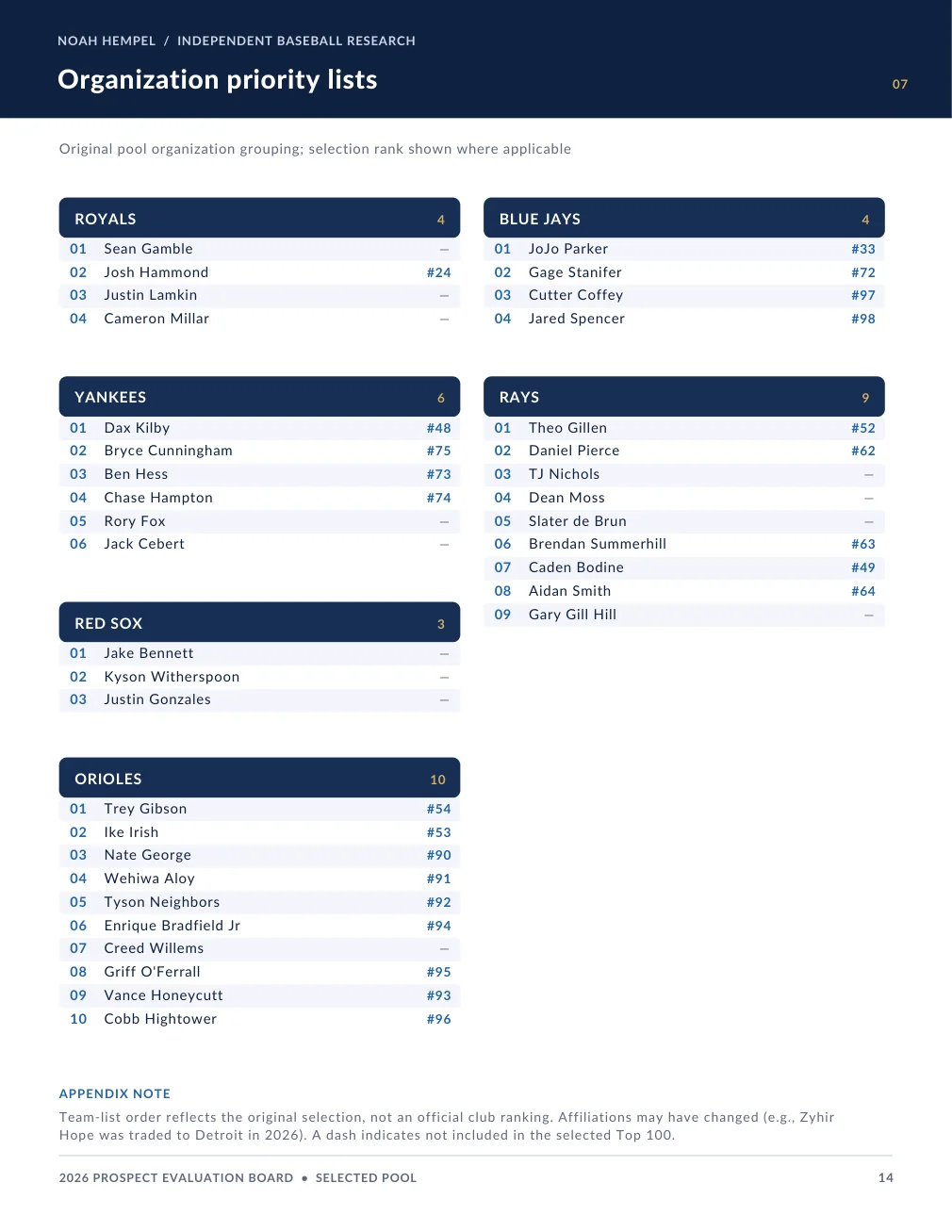
APPENDIX NOTE
Team-list order reflects the original selection, not an official club ranking. Affiliations may have changed (e.g., Zyhir
Hope was traded to Detroit in 2026). A dash indicates not included in the selected Top 100.
Page 16
NOAH HEMPEL  /  INDEPENDENT BASEBALL RESEARCH
References, scope & limitations
08
Public sources for selected examples, plus data-quality limitations
2026 PROSPECT EVALUATION BOARD  •  SELECTED POOL
15
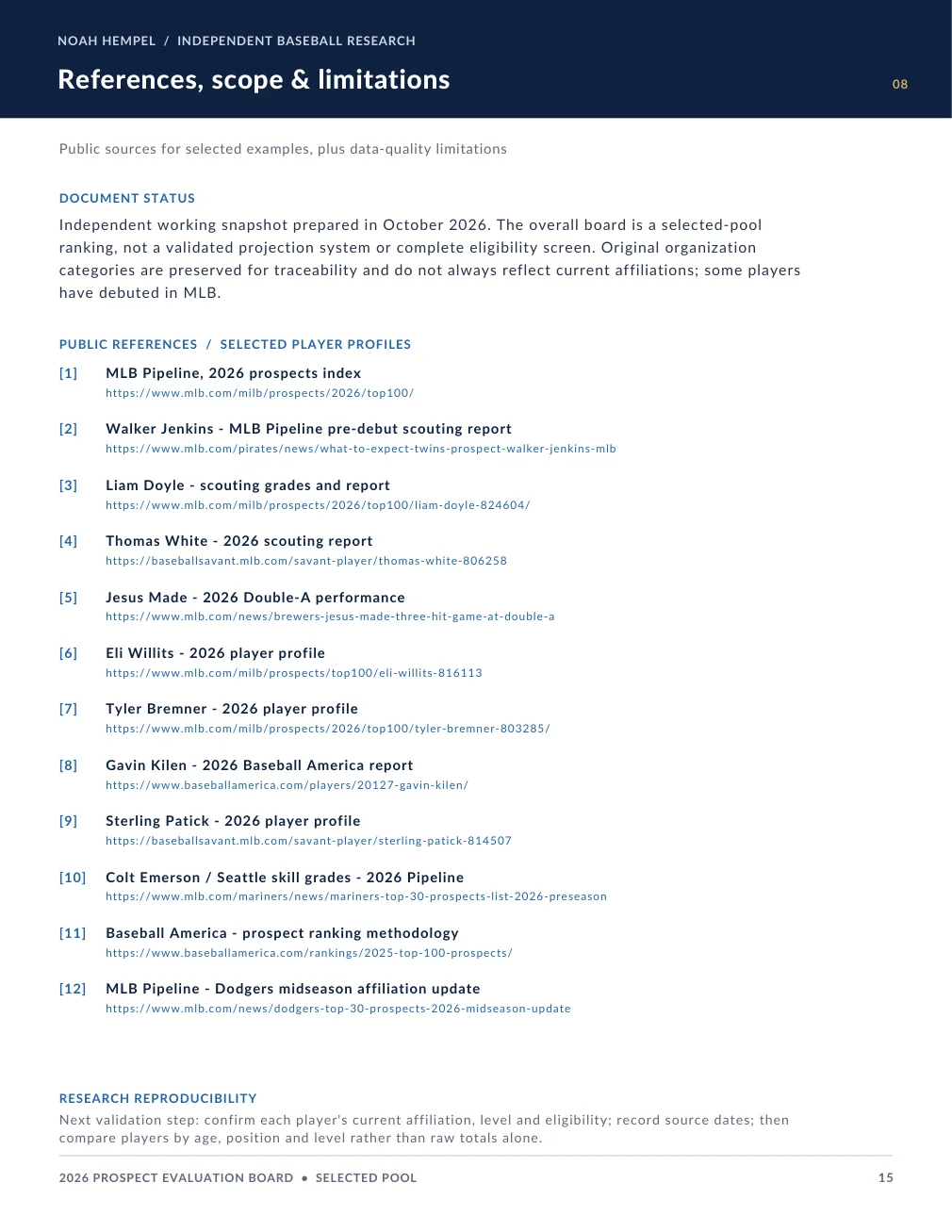
DOCUMENT STATUS
Independent working snapshot prepared in October 2026. The overall board is a selected-pool
ranking, not a validated projection system or complete eligibility screen. Original organization
categories are preserved for traceability and do not always reflect current affiliations; some players
have debuted in MLB.
PUBLIC REFERENCES  /  SELECTED PLAYER PROFILES
[1]
MLB Pipeline, 2026 prospects index
https://www.mlb.com/milb/prospects/2026/top100/
[2]
Walker Jenkins - MLB Pipeline pre-debut scouting report
https://www.mlb.com/pirates/news/what-to-expect-twins-prospect-walker-jenkins-mlb
[3]
Liam Doyle - scouting grades and report
https://www.mlb.com/milb/prospects/2026/top100/liam-doyle-824604/
[4]
Thomas White - 2026 scouting report
https://baseballsavant.mlb.com/savant-player/thomas-white-806258
[5]
Jesus Made - 2026 Double-A performance
https://www.mlb.com/news/brewers-jesus-made-three-hit-game-at-double-a
[6]
Eli Willits - 2026 player profile
https://www.mlb.com/milb/prospects/top100/eli-willits-816113
[7]
Tyler Bremner - 2026 player profile
https://www.mlb.com/milb/prospects/2026/top100/tyler-bremner-803285/
[8]
Gavin Kilen - 2026 Baseball America report
https://www.baseballamerica.com/players/20127-gavin-kilen/
[9]
Sterling Patick - 2026 player profile
https://baseballsavant.mlb.com/savant-player/sterling-patick-814507
[10]
Colt Emerson / Seattle skill grades - 2026 Pipeline
https://www.mlb.com/mariners/news/mariners-top-30-prospects-list-2026-preseason
[11]
Baseball America - prospect ranking methodology
https://www.baseballamerica.com/rankings/2025-top-100-prospects/
[12]
MLB Pipeline - Dodgers midseason affiliation update
https://www.mlb.com/news/dodgers-top-30-prospects-2026-midseason-update
RESEARCH REPRODUCIBILITY
Next validation step: confirm each player's current affiliation, level and eligibility; record source dates; then
compare players by age, position and level rather than raw totals alone.
Page 17
NOAH HEMPEL   /   INDEPENDENT BASEBALL RESEARCH
Dodgers Organizational Philosophy | Qualitative Analysis
BASEBALL OPERATIONS RESEARCH PORTFOLIO   |   OCTOBER 2026
RESEARCH NOTE / 02
Organizational Philosophy Analysis
Los Angeles Dodgers
Andrew Friedman era | Independent qualitative assessment | October 2026
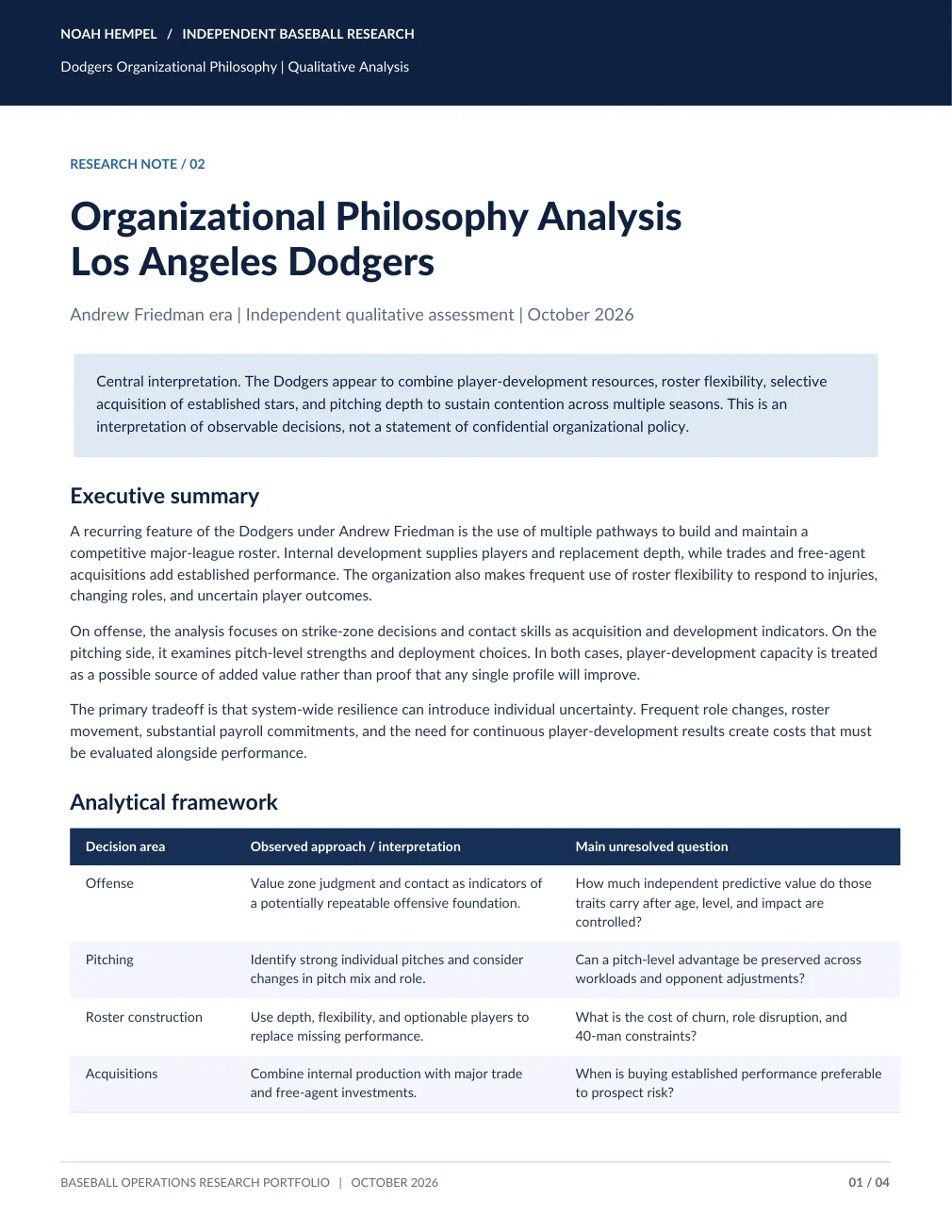
Central interpretation. The Dodgers appear to combine player-development resources, roster flexibility, selective
acquisition of established stars, and pitching depth to sustain contention across multiple seasons. This is an
interpretation of observable decisions, not a statement of confidential organizational policy.
Executive summary
A recurring feature of the Dodgers under Andrew Friedman is the use of multiple pathways to build and maintain a
competitive major-league roster. Internal development supplies players and replacement depth, while trades and free-agent
acquisitions add established performance. The organization also makes frequent use of roster flexibility to respond to injuries,
changing roles, and uncertain player outcomes.
On offense, the analysis focuses on strike-zone decisions and contact skills as acquisition and development indicators. On the
pitching side, it examines pitch-level strengths and deployment choices. In both cases, player-development capacity is treated
as a possible source of added value rather than proof that any single profile will improve.
The primary tradeoff is that system-wide resilience can introduce individual uncertainty. Frequent role changes, roster
movement, substantial payroll commitments, and the need for continuous player-development results create costs that must
be evaluated alongside performance.
Analytical framework
Decision area
Observed approach / interpretation
Main unresolved question
Offense
Value zone judgment and contact as indicators of
a potentially repeatable offensive foundation.
How much independent predictive value do those
traits carry after age, level, and impact are
controlled?
Pitching
Identify strong individual pitches and consider
changes in pitch mix and role.
Can a pitch-level advantage be preserved across
workloads and opponent adjustments?
Roster construction
Use depth, flexibility, and optionable players to
replace missing performance.
What is the cost of churn, role disruption, and
40-man constraints?
Acquisitions
Combine internal production with major trade
and free-agent investments.
When is buying established performance preferable
to prospect risk?
01 / 04
Page 18
NOAH HEMPEL   /   INDEPENDENT BASEBALL RESEARCH
Dodgers Organizational Philosophy | Qualitative Analysis
BASEBALL OPERATIONS RESEARCH PORTFOLIO   |   OCTOBER 2026
1 | Offensive acquisition and development
This evaluation places particular emphasis on hitters who demonstrate strike-zone judgment, manageable swing-and-miss, and
the ability to produce competitive plate appearances. These traits may support a more predictable offensive baseline, but walk
and strikeout rates cannot independently establish chase rate, contact quality, or future productivity.
Max Muncy: a useful case, but not proof of exclusive Dodgers development
Muncy’s move from Oakland to Los Angeles illustrates the possible value of pairing an existing plate-discipline foundation with
changes in offensive approach. Contemporary reporting documents mechanical work Muncy undertook with his father before
joining the Dodgers and subsequent refinements to his offensive approach within the organization [1]. It would therefore
overstate the evidence to attribute his entire power transformation to Dodgers coaching.
The broader principle remains relevant: an evaluator may find players whose underlying skills are better than their current
outcomes. Whether improvements are attributable to coaching, player-led changes, health, opportunity, or all of the above
must be established rather than assumed.
Will Smith and the role of internal development
Will Smith provides a separate example of a homegrown player whose offensive contribution became an important part of the
major-league roster. His progression can be examined as evidence that established organizational development processes may
contribute to both floor and ceiling. Without a comparative study, however, it cannot establish that the club systematically
develops power more effectively than every other organization.
2 | Pitching acquisition and deployment
A pitch-level approach identifies characteristics such as velocity, movement, release properties, extension, location, and a
pitch’s ability to generate misses or weak contact. Rather than treating a pitcher’s prior ERA as a complete description, an
evaluator can ask whether a different mix or deployment would better exploit existing strengths.
Evan Phillips is an illustrative hypothesis: his success as a Dodgers reliever invites a closer look at sweeper/slider usage, pitch
quality, and role fit. A validated case study would compare season-by-season usage and performance against a relevant
baseline before crediting a specific pitch-mix adjustment with the improvement.
Durability still matters. The organization can value pitchers capable of providing a stable workload while also building
replacements for periods of injury or inconsistent performance.
02 / 04
Page 19
NOAH HEMPEL   /   INDEPENDENT BASEBALL RESEARCH
Dodgers Organizational Philosophy | Qualitative Analysis
BASEBALL OPERATIONS RESEARCH PORTFOLIO   |   OCTOBER 2026
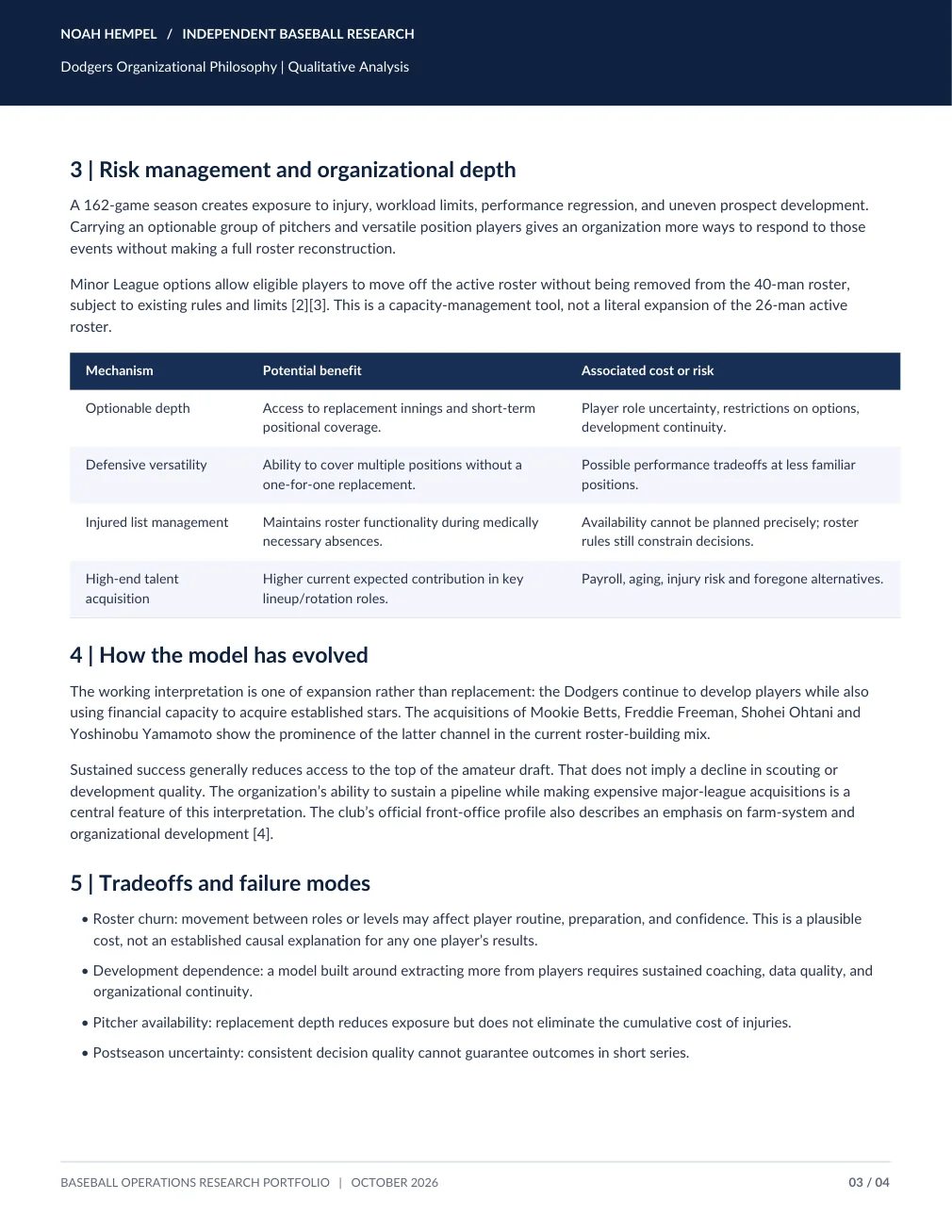
3 | Risk management and organizational depth
A 162-game season creates exposure to injury, workload limits, performance regression, and uneven prospect development.
Carrying an optionable group of pitchers and versatile position players gives an organization more ways to respond to those
events without making a full roster reconstruction.
Minor League options allow eligible players to move off the active roster without being removed from the 40-man roster,
subject to existing rules and limits [2][3]. This is a capacity-management tool, not a literal expansion of the 26-man active
roster.
Mechanism
Potential benefit
Associated cost or risk
Optionable depth
Access to replacement innings and short-term
positional coverage.
Player role uncertainty, restrictions on options,
development continuity.
Defensive versatility
Ability to cover multiple positions without a
one-for-one replacement.
Possible performance tradeoffs at less familiar
positions.
Injured list management
Maintains roster functionality during medically
necessary absences.
Availability cannot be planned precisely; roster
rules still constrain decisions.
High-end talent
acquisition
Higher current expected contribution in key
lineup/rotation roles.
Payroll, aging, injury risk and foregone alternatives.
4 | How the model has evolved
The working interpretation is one of expansion rather than replacement: the Dodgers continue to develop players while also
using financial capacity to acquire established stars. The acquisitions of Mookie Betts, Freddie Freeman, Shohei Ohtani and
Yoshinobu Yamamoto show the prominence of the latter channel in the current roster-building mix.
Sustained success generally reduces access to the top of the amateur draft. That does not imply a decline in scouting or
development quality. The organization’s ability to sustain a pipeline while making expensive major-league acquisitions is a
central feature of this interpretation. The club’s official front-office profile also describes an emphasis on farm-system and
organizational development [4].
5 | Tradeoffs and failure modes
• Roster churn: movement between roles or levels may affect player routine, preparation, and confidence. This is a plausible
cost, not an established causal explanation for any one player’s results.
• Development dependence: a model built around extracting more from players requires sustained coaching, data quality, and
organizational continuity.
• Pitcher availability: replacement depth reduces exposure but does not eliminate the cumulative cost of injuries.
• Postseason uncertainty: consistent decision quality cannot guarantee outcomes in short series.
03 / 04
Page 20
NOAH HEMPEL   /   INDEPENDENT BASEBALL RESEARCH
Dodgers Organizational Philosophy | Qualitative Analysis
BASEBALL OPERATIONS RESEARCH PORTFOLIO   |   OCTOBER 2026
Interpretation & remaining tests
Working conclusion. A large component of sustained contention may come from having several viable ways to
replace or improve roster value, rather than expecting individual players to remain healthy or develop on schedule.
What would strengthen this analysis
• Create a comparable dataset of plate-discipline metrics for Dodgers acquisitions versus league or peer-team baselines.
• Measure pitcher pitch-mix changes before and after acquisition, accounting for role, handedness, velocity and sample size.
• Track player option usage, injured-list days, depth replacements and corresponding team performance by season.
• Compare payroll allocation and prospect outputs with other consistent contenders using a common time window.
Scope and limitations
This is qualitative organizational analysis developed from public information and the author’s interpretation. It is not an
internal operations document, a validated causal study, or a claim of access to proprietary Dodgers practices. Stronger causal
conclusions require a specified sample, comparator, and alternative explanations.
References & document basis
[1] MLB (2018), Muncy development and adjustments
https://www.mlb.com/news/how-max-muncy-has-become-a-slugger-for-dodgers-c281819544
[2] MLB Glossary, Minor League options
https://www.mlb.com/glossary/transactions/minor-league-options
[3] MLB Glossary, 40-man roster
https://www.mlb.com/glossary/transactions/40-man-roster
[4] Dodgers official profile, Andrew Friedman
https://www.mlb.com/dodgers/team/front-office/andrew-friedman
04 / 04
Page 21
NOAH HEMPEL   /   INDEPENDENT BASEBALL RESEARCH
Ninefold Baseball | Product Case Study
BASEBALL OPERATIONS RESEARCH PORTFOLIO   |   OCTOBER 2026
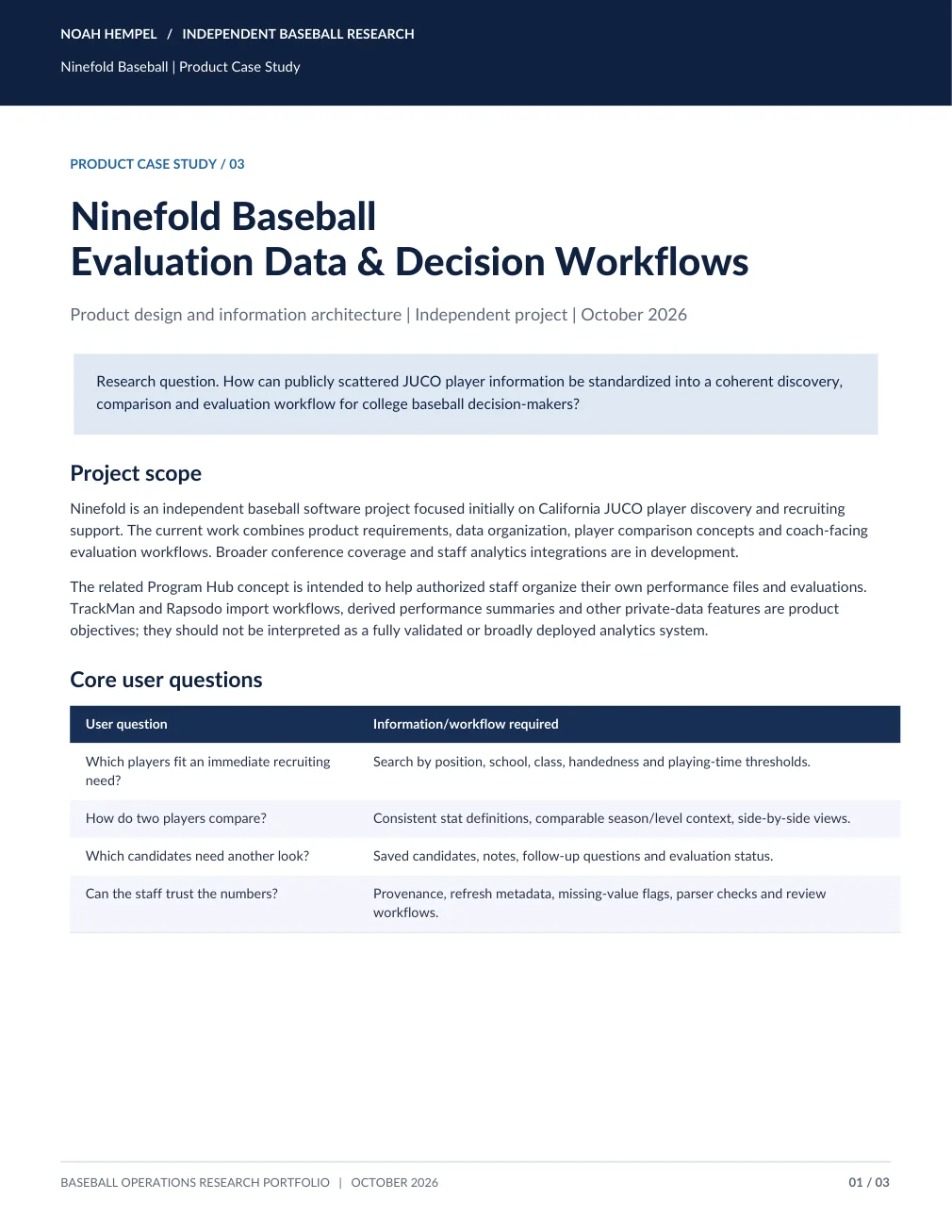
PRODUCT CASE STUDY / 03
Ninefold Baseball
Evaluation Data & Decision Workflows
Product design and information architecture | Independent project | October 2026
Research question. How can publicly scattered JUCO player information be standardized into a coherent discovery,
comparison and evaluation workflow for college baseball decision-makers?
Project scope
Ninefold is an independent baseball software project focused initially on California JUCO player discovery and recruiting
support. The current work combines product requirements, data organization, player comparison concepts and coach-facing
evaluation workflows. Broader conference coverage and staff analytics integrations are in development.
The related Program Hub concept is intended to help authorized staff organize their own performance files and evaluations.
TrackMan and Rapsodo import workflows, derived performance summaries and other private-data features are product
objectives; they should not be interpreted as a fully validated or broadly deployed analytics system.
Core user questions
User question
Information/workflow required
Which players fit an immediate recruiting
need?
Search by position, school, class, handedness and playing-time thresholds.
How do two players compare?
Consistent stat definitions, comparable season/level context, side-by-side views.
Which candidates need another look?
Saved candidates, notes, follow-up questions and evaluation status.
Can the staff trust the numbers?
Provenance, refresh metadata, missing-value flags, parser checks and review
workflows.
01 / 03
Page 22
NOAH HEMPEL   /   INDEPENDENT BASEBALL RESEARCH
Ninefold Baseball | Product Case Study
BASEBALL OPERATIONS RESEARCH PORTFOLIO   |   OCTOBER 2026
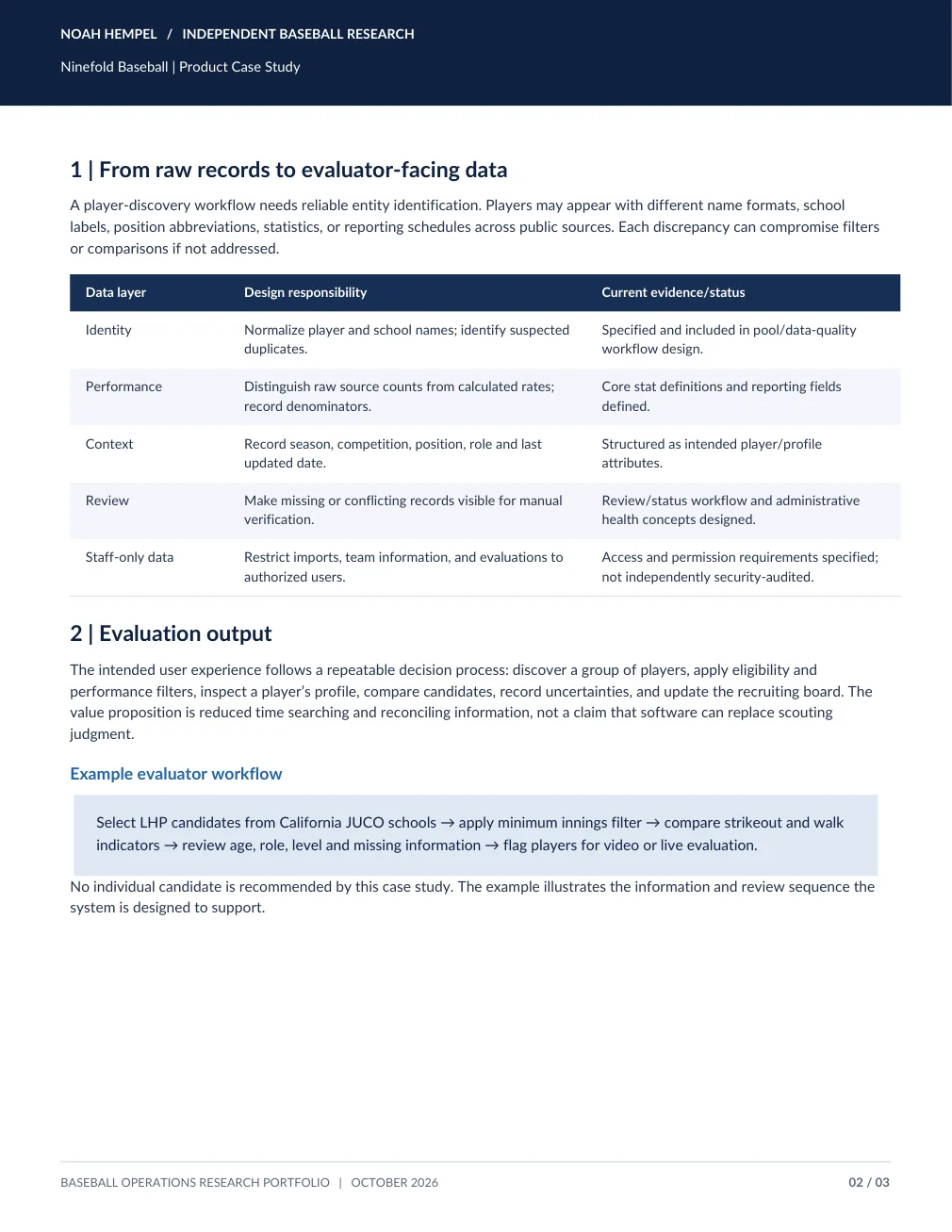
1 | From raw records to evaluator-facing data
A player-discovery workflow needs reliable entity identification. Players may appear with different name formats, school
labels, position abbreviations, statistics, or reporting schedules across public sources. Each discrepancy can compromise filters
or comparisons if not addressed.
Data layer
Design responsibility
Current evidence/status
Identity
Normalize player and school names; identify suspected
duplicates.
Specified and included in pool/data-quality
workflow design.
Performance
Distinguish raw source counts from calculated rates;
record denominators.
Core stat definitions and reporting fields
defined.
Context
Record season, competition, position, role and last
updated date.
Structured as intended player/profile
attributes.
Review
Make missing or conflicting records visible for manual
verification.
Review/status workflow and administrative
health concepts designed.
Staff-only data
Restrict imports, team information, and evaluations to
authorized users.
Access and permission requirements specified;
not independently security-audited.
2 | Evaluation output
The intended user experience follows a repeatable decision process: discover a group of players, apply eligibility and
performance filters, inspect a player’s profile, compare candidates, record uncertainties, and update the recruiting board. The
value proposition is reduced time searching and reconciling information, not a claim that software can replace scouting
judgment.
Example evaluator workflow
Select LHP candidates from California JUCO schools → apply minimum innings filter → compare strikeout and walk
indicators → review age, role, level and missing information → flag players for video or live evaluation.
No individual candidate is recommended by this case study. The example illustrates the information and review sequence the
system is designed to support.
02 / 03
Page 23
NOAH HEMPEL   /   INDEPENDENT BASEBALL RESEARCH
Ninefold Baseball | Product Case Study
BASEBALL OPERATIONS RESEARCH PORTFOLIO   |   OCTOBER 2026
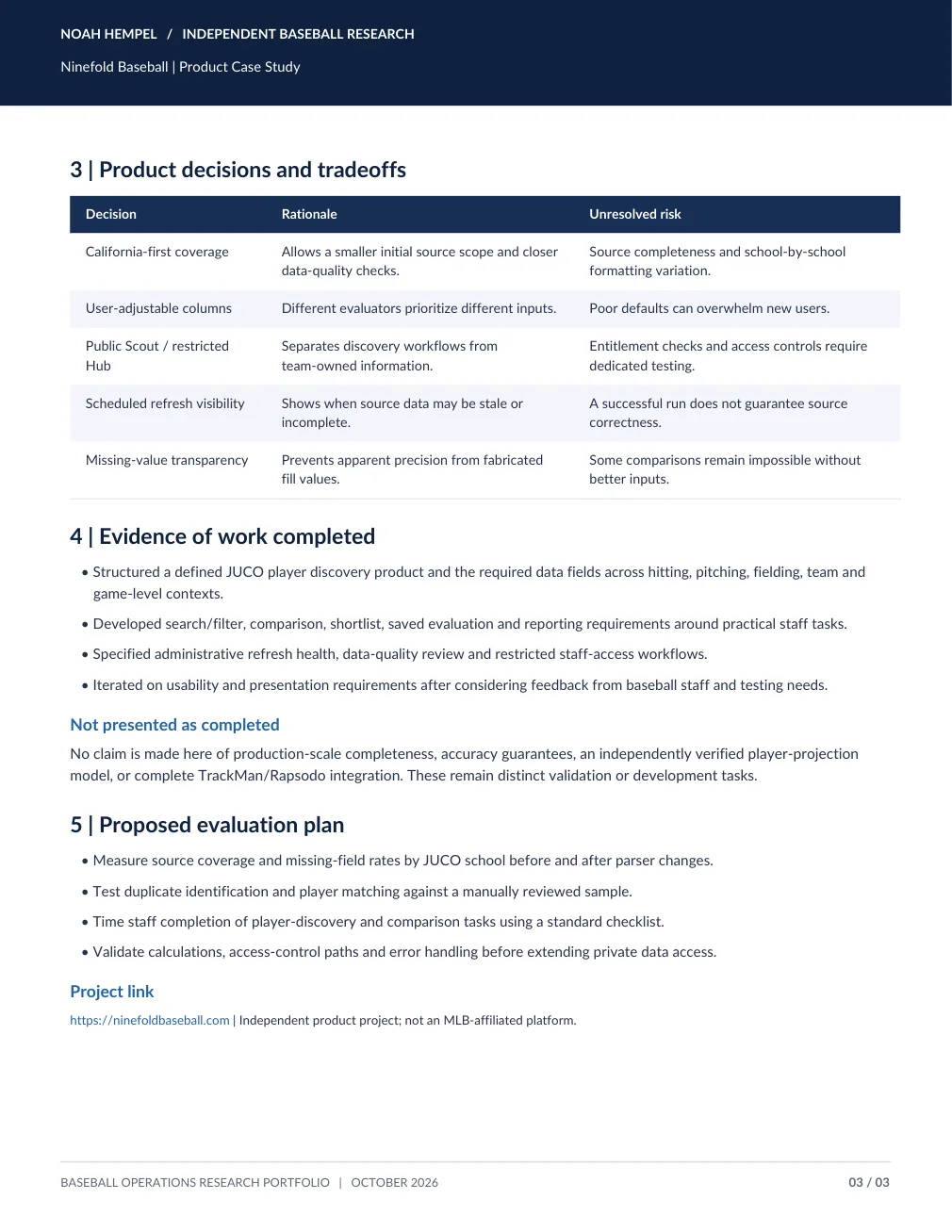
3 | Product decisions and tradeoffs
Decision
Rationale
Unresolved risk
California-first coverage
Allows a smaller initial source scope and closer
data-quality checks.
Source completeness and school-by-school
formatting variation.
User-adjustable columns
Different evaluators prioritize different inputs.
Poor defaults can overwhelm new users.
Public Scout / restricted
Hub
Separates discovery workflows from
team-owned information.
Entitlement checks and access controls require
dedicated testing.
Scheduled refresh visibility
Shows when source data may be stale or
incomplete.
A successful run does not guarantee source
correctness.
Missing-value transparency
Prevents apparent precision from fabricated
fill values.
Some comparisons remain impossible without
better inputs.
4 | Evidence of work completed
• Structured a defined JUCO player discovery product and the required data fields across hitting, pitching, fielding, team and
game-level contexts.
• Developed search/filter, comparison, shortlist, saved evaluation and reporting requirements around practical staff tasks.
• Specified administrative refresh health, data-quality review and restricted staff-access workflows.
• Iterated on usability and presentation requirements after considering feedback from baseball staff and testing needs.
Not presented as completed
No claim is made here of production-scale completeness, accuracy guarantees, an independently verified player-projection
model, or complete TrackMan/Rapsodo integration. These remain distinct validation or development tasks.
5 | Proposed evaluation plan
• Measure source coverage and missing-field rates by JUCO school before and after parser changes.
• Test duplicate identification and player matching against a manually reviewed sample.
• Time staff completion of player-discovery and comparison tasks using a standard checklist.
• Validate calculations, access-control paths and error handling before extending private data access.
Project link
https://ninefoldbaseball.com | Independent product project; not an MLB-affiliated platform.
03 / 03
Page 24
NOAH HEMPEL   /   INDEPENDENT BASEBALL RESEARCH
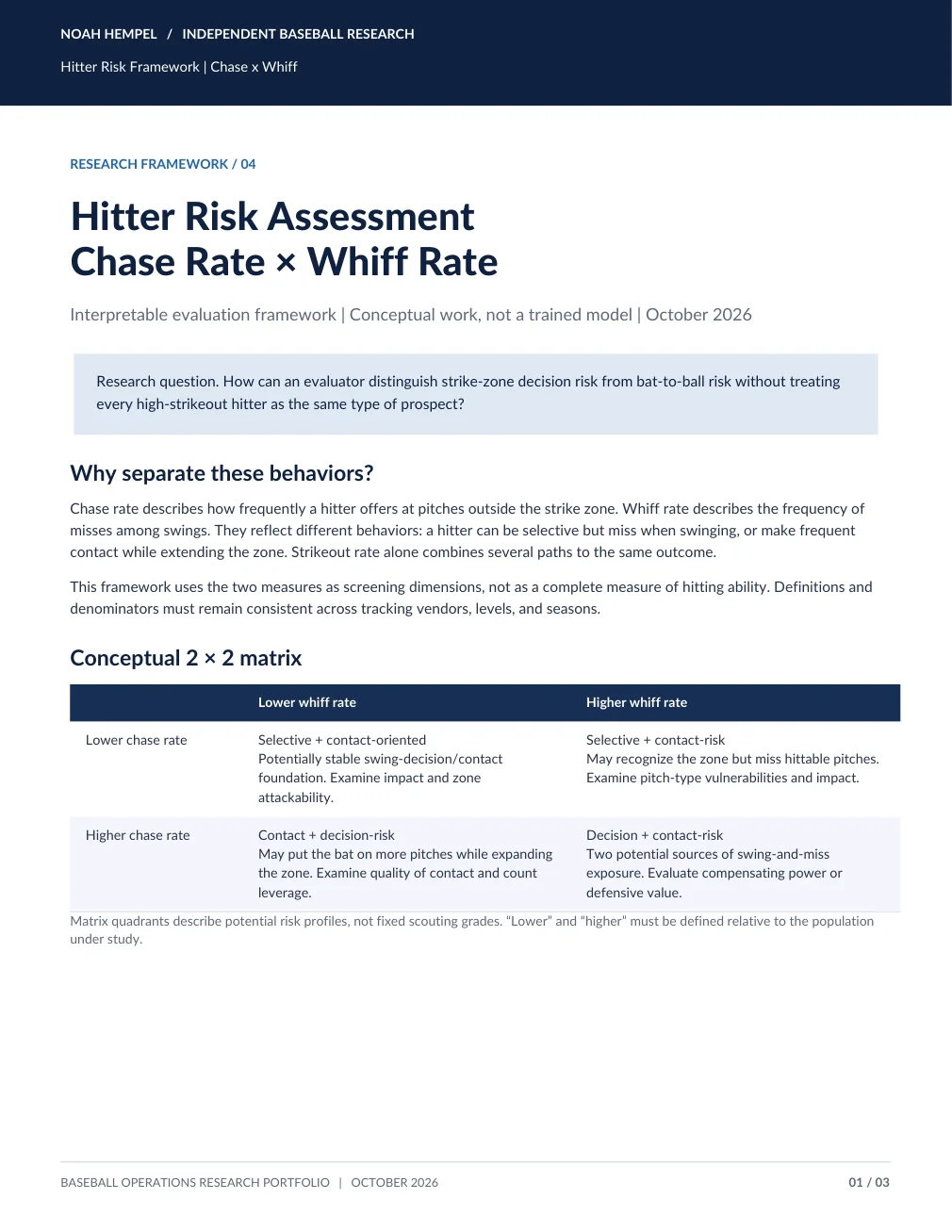
Hitter Risk Framework | Chase x Whiff
BASEBALL OPERATIONS RESEARCH PORTFOLIO   |   OCTOBER 2026
RESEARCH FRAMEWORK / 04
Hitter Risk Assessment
Chase Rate × Whiff Rate
Interpretable evaluation framework | Conceptual work, not a trained model | October 2026
Research question. How can an evaluator distinguish strike-zone decision risk from bat-to-ball risk without treating
every high-strikeout hitter as the same type of prospect?
Why separate these behaviors?
Chase rate describes how frequently a hitter offers at pitches outside the strike zone. Whiff rate describes the frequency of
misses among swings. They reflect different behaviors: a hitter can be selective but miss when swinging, or make frequent
contact while extending the zone. Strikeout rate alone combines several paths to the same outcome.
This framework uses the two measures as screening dimensions, not as a complete measure of hitting ability. Definitions and
denominators must remain consistent across tracking vendors, levels, and seasons.
Conceptual 2 × 2 matrix
Lower whiff rate
Higher whiff rate
Lower chase rate
Selective + contact-oriented
Potentially stable swing-decision/contact
foundation. Examine impact and zone
attackability.
Selective + contact-risk
May recognize the zone but miss hittable pitches.
Examine pitch-type vulnerabilities and impact.
Higher chase rate
Contact + decision-risk
May put the bat on more pitches while expanding
the zone. Examine quality of contact and count
leverage.
Decision + contact-risk
Two potential sources of swing-and-miss
exposure. Evaluate compensating power or
defensive value.
Matrix quadrants describe potential risk profiles, not fixed scouting grades. “Lower” and “higher” must be defined relative to the population
under study.
01 / 03
Page 25
NOAH HEMPEL   /   INDEPENDENT BASEBALL RESEARCH
Hitter Risk Framework | Chase x Whiff
BASEBALL OPERATIONS RESEARCH PORTFOLIO   |   OCTOBER 2026
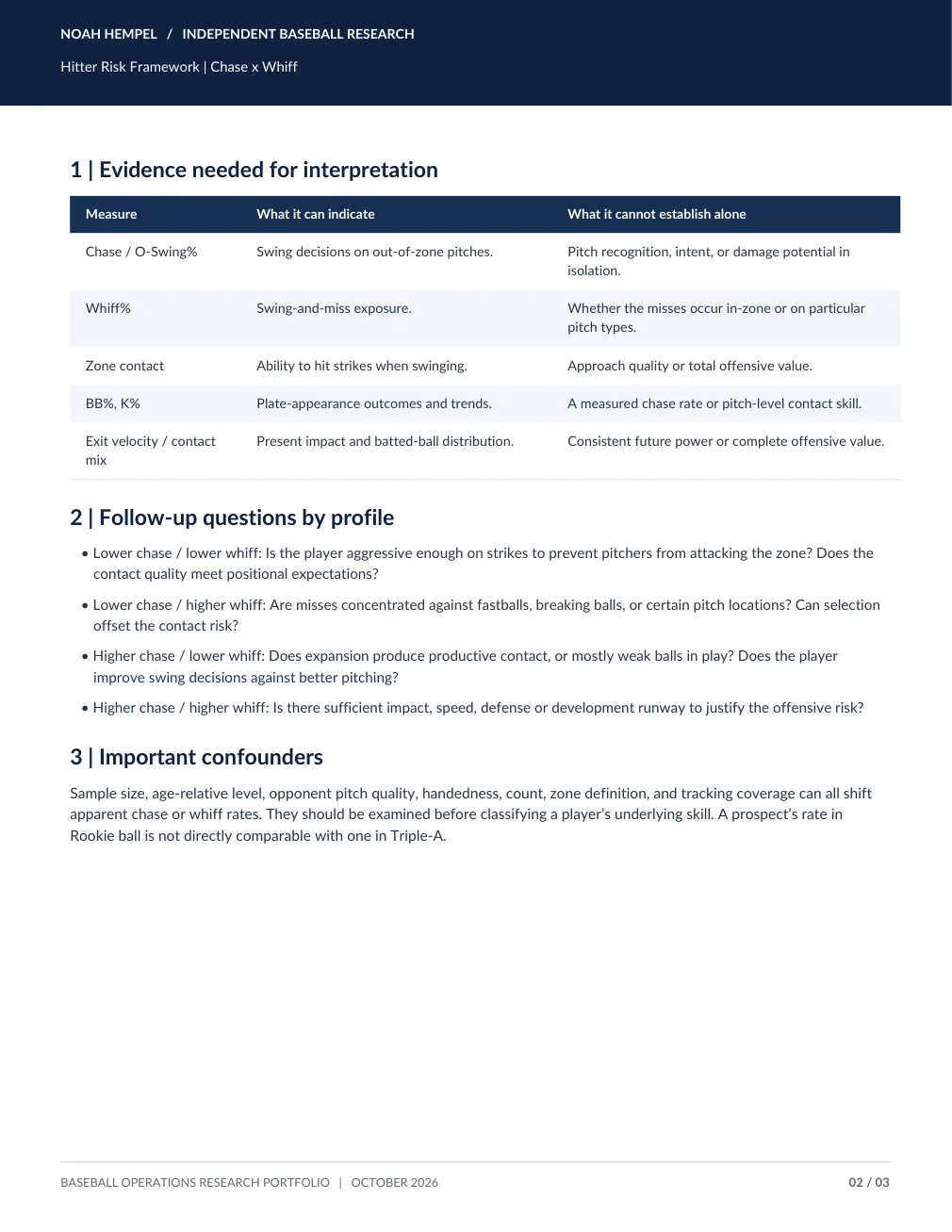
1 | Evidence needed for interpretation
Measure
What it can indicate
What it cannot establish alone
Chase / O-Swing%
Swing decisions on out-of-zone pitches.
Pitch recognition, intent, or damage potential in
isolation.
Whiff%
Swing-and-miss exposure.
Whether the misses occur in-zone or on particular
pitch types.
Zone contact
Ability to hit strikes when swinging.
Approach quality or total offensive value.
BB%, K%
Plate-appearance outcomes and trends.
A measured chase rate or pitch-level contact skill.
Exit velocity / contact
mix
Present impact and batted-ball distribution.
Consistent future power or complete offensive value.
2 | Follow-up questions by profile
• Lower chase / lower whiff: Is the player aggressive enough on strikes to prevent pitchers from attacking the zone? Does the
contact quality meet positional expectations?
• Lower chase / higher whiff: Are misses concentrated against fastballs, breaking balls, or certain pitch locations? Can selection
offset the contact risk?
• Higher chase / lower whiff: Does expansion produce productive contact, or mostly weak balls in play? Does the player
improve swing decisions against better pitching?
• Higher chase / higher whiff: Is there sufficient impact, speed, defense or development runway to justify the offensive risk?
3 | Important confounders
Sample size, age-relative level, opponent pitch quality, handedness, count, zone definition, and tracking coverage can all shift
apparent chase or whiff rates. They should be examined before classifying a player’s underlying skill. A prospect’s rate in
Rookie ball is not directly comparable with one in Triple-A.
02 / 03
Page 26
NOAH HEMPEL   /   INDEPENDENT BASEBALL RESEARCH
Hitter Risk Framework | Chase x Whiff
BASEBALL OPERATIONS RESEARCH PORTFOLIO   |   OCTOBER 2026
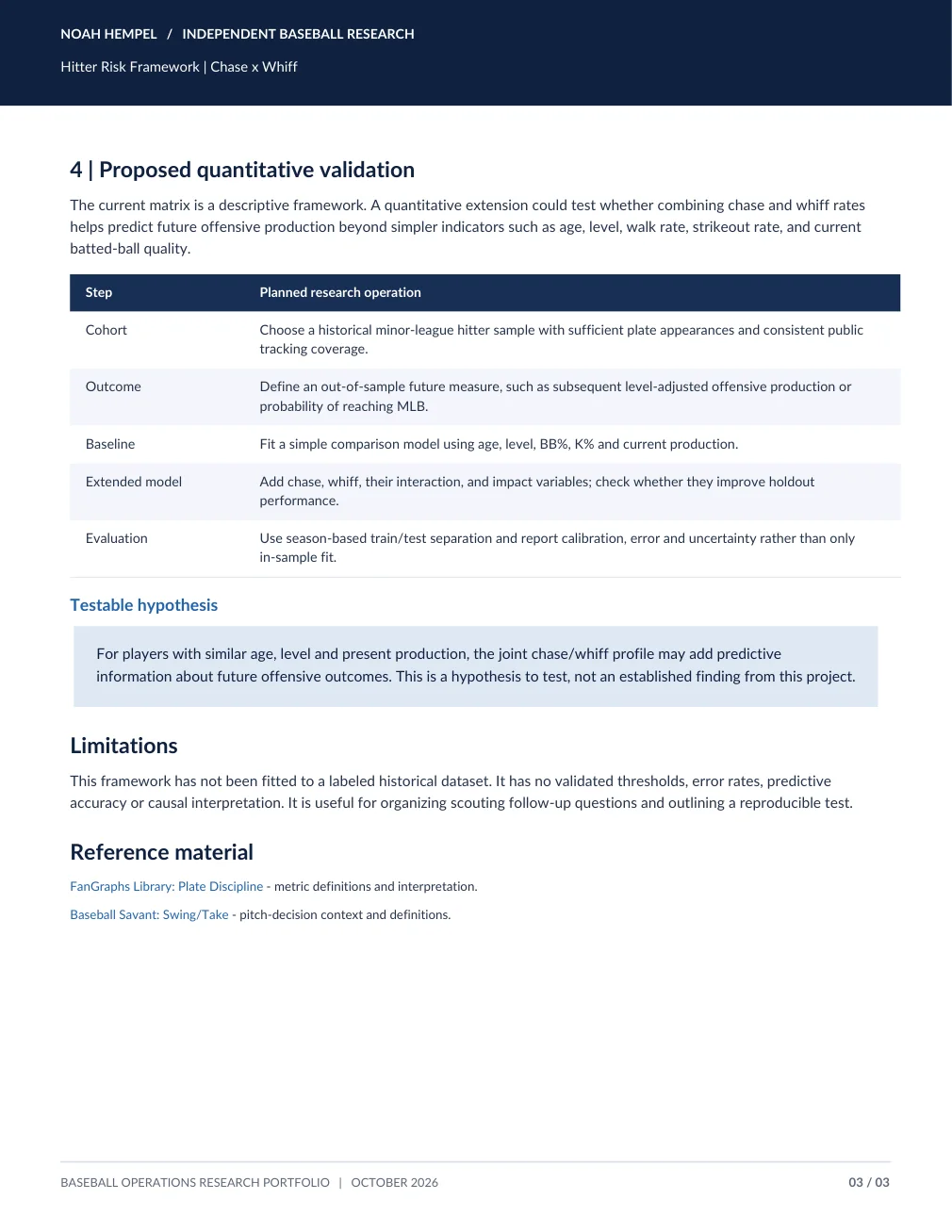
4 | Proposed quantitative validation
The current matrix is a descriptive framework. A quantitative extension could test whether combining chase and whiff rates
helps predict future offensive production beyond simpler indicators such as age, level, walk rate, strikeout rate, and current
batted-ball quality.
Step
Planned research operation
Cohort
Choose a historical minor-league hitter sample with sufficient plate appearances and consistent public
tracking coverage.
Outcome
Define an out-of-sample future measure, such as subsequent level-adjusted offensive production or
probability of reaching MLB.
Baseline
Fit a simple comparison model using age, level, BB%, K% and current production.
Extended model
Add chase, whiff, their interaction, and impact variables; check whether they improve holdout
performance.
Evaluation
Use season-based train/test separation and report calibration, error and uncertainty rather than only
in-sample fit.
Testable hypothesis
For players with similar age, level and present production, the joint chase/whiff profile may add predictive
information about future offensive outcomes. This is a hypothesis to test, not an established finding from this project.
Limitations
This framework has not been fitted to a labeled historical dataset. It has no validated thresholds, error rates, predictive
accuracy or causal interpretation. It is useful for organizing scouting follow-up questions and outlining a reproducible test.
Reference material
FanGraphs Library: Plate Discipline - metric definitions and interpretation.
Baseball Savant: Swing/Take - pitch-decision context and definitions.
03 / 03