Organizational strategy · 2026
Los Angeles Dodgers Organizational Philosophy Analysis
An examination of player acquisition, development, roster flexibility and depth under Andrew Friedman, including the costs and tradeoffs of sustaining contention.
Independent qualitative analysis
Considers offensive foundations, pitch-level development, acquisitions, roster construction and risk management. Conclusions are interpretations of observable decisions, not confidential Dodgers policy or causal estimates.
The original PDF and the pages below are hosted directly on this website. If your browser does not display the embedded document, open the original PDF or use the page-by-page reader.

Read document text (accessible alternative)
Text extracted from the original PDF. Tables may lose alignment; consult the original for layout.
Page 1
NOAH HEMPEL   /   INDEPENDENT BASEBALL RESEARCH
Dodgers Organizational Philosophy | Qualitative Analysis
BASEBALL OPERATIONS RESEARCH PORTFOLIO   |   OCTOBER 2026
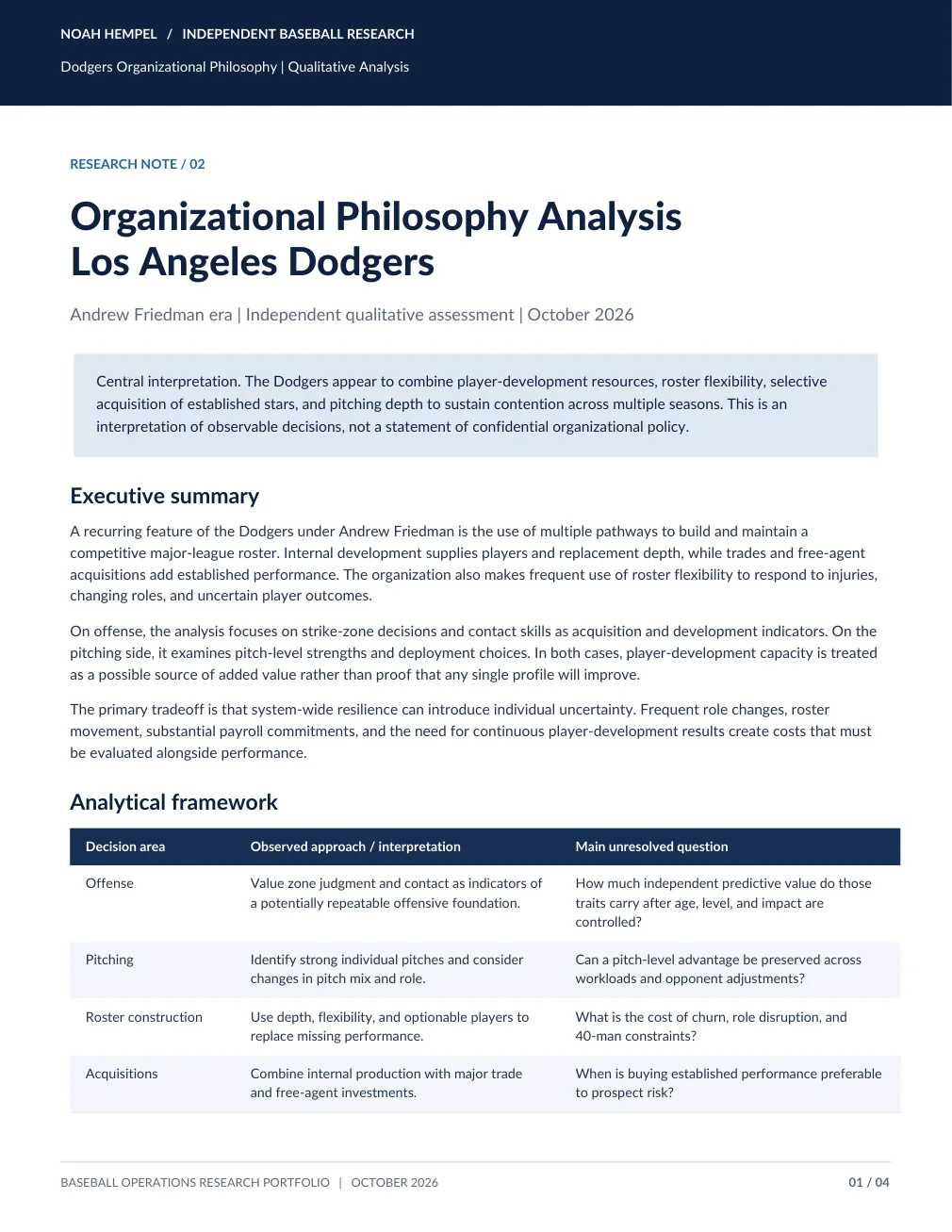
RESEARCH NOTE / 02
Organizational Philosophy Analysis
Los Angeles Dodgers
Andrew Friedman era | Independent qualitative assessment | October 2026
Central interpretation. The Dodgers appear to combine player-development resources, roster flexibility, selective
acquisition of established stars, and pitching depth to sustain contention across multiple seasons. This is an
interpretation of observable decisions, not a statement of confidential organizational policy.
Executive summary
A recurring feature of the Dodgers under Andrew Friedman is the use of multiple pathways to build and maintain a
competitive major-league roster. Internal development supplies players and replacement depth, while trades and free-agent
acquisitions add established performance. The organization also makes frequent use of roster flexibility to respond to injuries,
changing roles, and uncertain player outcomes.
On offense, the analysis focuses on strike-zone decisions and contact skills as acquisition and development indicators. On the
pitching side, it examines pitch-level strengths and deployment choices. In both cases, player-development capacity is treated
as a possible source of added value rather than proof that any single profile will improve.
The primary tradeoff is that system-wide resilience can introduce individual uncertainty. Frequent role changes, roster
movement, substantial payroll commitments, and the need for continuous player-development results create costs that must
be evaluated alongside performance.
Analytical framework
Decision area
Observed approach / interpretation
Main unresolved question
Offense
Value zone judgment and contact as indicators of
a potentially repeatable offensive foundation.
How much independent predictive value do those
traits carry after age, level, and impact are
controlled?
Pitching
Identify strong individual pitches and consider
changes in pitch mix and role.
Can a pitch-level advantage be preserved across
workloads and opponent adjustments?
Roster construction
Use depth, flexibility, and optionable players to
replace missing performance.
What is the cost of churn, role disruption, and
40-man constraints?
Acquisitions
Combine internal production with major trade
and free-agent investments.
When is buying established performance preferable
to prospect risk?
01 / 04
Page 2
NOAH HEMPEL   /   INDEPENDENT BASEBALL RESEARCH
Dodgers Organizational Philosophy | Qualitative Analysis
BASEBALL OPERATIONS RESEARCH PORTFOLIO   |   OCTOBER 2026
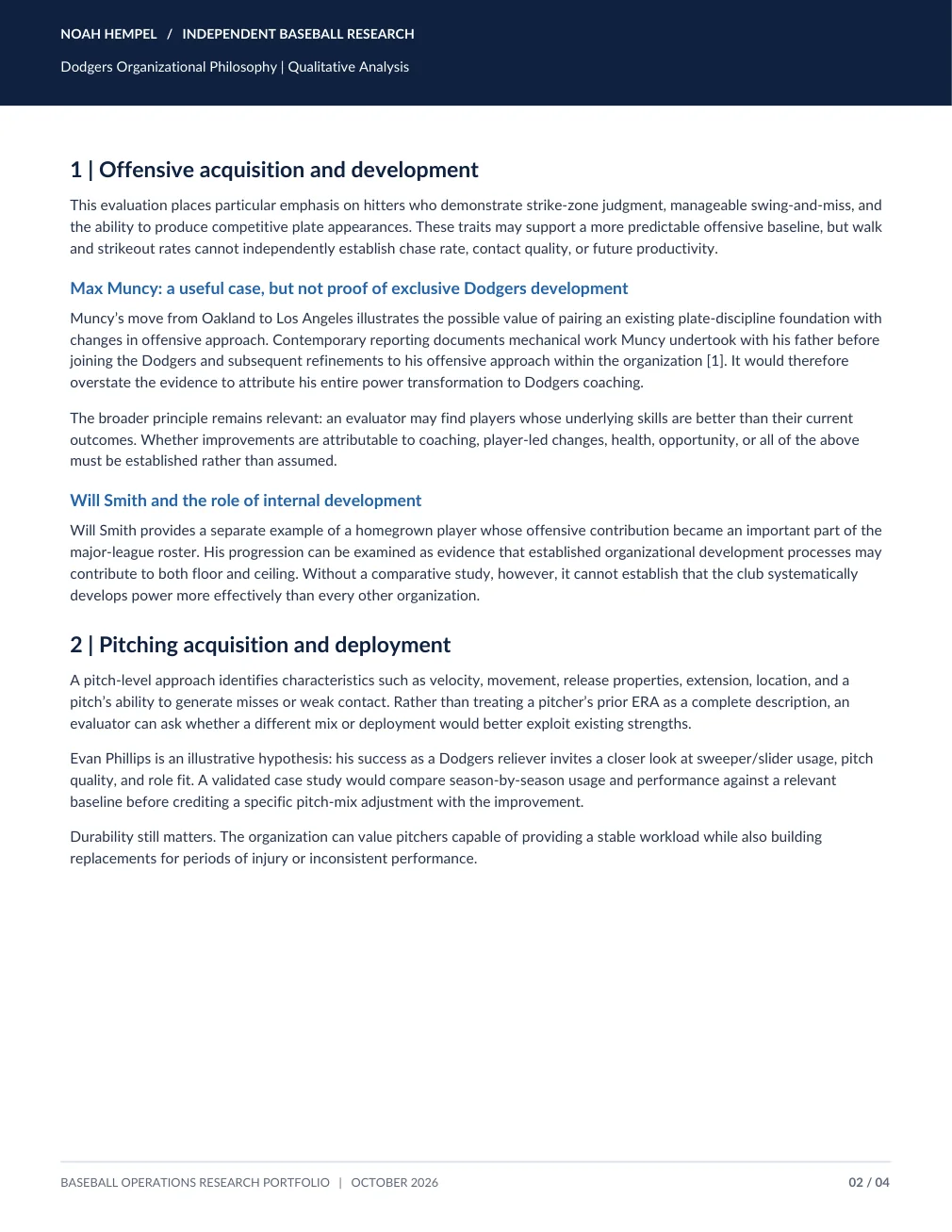
1 | Offensive acquisition and development
This evaluation places particular emphasis on hitters who demonstrate strike-zone judgment, manageable swing-and-miss, and
the ability to produce competitive plate appearances. These traits may support a more predictable offensive baseline, but walk
and strikeout rates cannot independently establish chase rate, contact quality, or future productivity.
Max Muncy: a useful case, but not proof of exclusive Dodgers development
Muncy’s move from Oakland to Los Angeles illustrates the possible value of pairing an existing plate-discipline foundation with
changes in offensive approach. Contemporary reporting documents mechanical work Muncy undertook with his father before
joining the Dodgers and subsequent refinements to his offensive approach within the organization [1]. It would therefore
overstate the evidence to attribute his entire power transformation to Dodgers coaching.
The broader principle remains relevant: an evaluator may find players whose underlying skills are better than their current
outcomes. Whether improvements are attributable to coaching, player-led changes, health, opportunity, or all of the above
must be established rather than assumed.
Will Smith and the role of internal development
Will Smith provides a separate example of a homegrown player whose offensive contribution became an important part of the
major-league roster. His progression can be examined as evidence that established organizational development processes may
contribute to both floor and ceiling. Without a comparative study, however, it cannot establish that the club systematically
develops power more effectively than every other organization.
2 | Pitching acquisition and deployment
A pitch-level approach identifies characteristics such as velocity, movement, release properties, extension, location, and a
pitch’s ability to generate misses or weak contact. Rather than treating a pitcher’s prior ERA as a complete description, an
evaluator can ask whether a different mix or deployment would better exploit existing strengths.
Evan Phillips is an illustrative hypothesis: his success as a Dodgers reliever invites a closer look at sweeper/slider usage, pitch
quality, and role fit. A validated case study would compare season-by-season usage and performance against a relevant
baseline before crediting a specific pitch-mix adjustment with the improvement.
Durability still matters. The organization can value pitchers capable of providing a stable workload while also building
replacements for periods of injury or inconsistent performance.
02 / 04
Page 3
NOAH HEMPEL   /   INDEPENDENT BASEBALL RESEARCH
Dodgers Organizational Philosophy | Qualitative Analysis
BASEBALL OPERATIONS RESEARCH PORTFOLIO   |   OCTOBER 2026
3 | Risk management and organizational depth
A 162-game season creates exposure to injury, workload limits, performance regression, and uneven prospect development.
Carrying an optionable group of pitchers and versatile position players gives an organization more ways to respond to those
events without making a full roster reconstruction.
Minor League options allow eligible players to move off the active roster without being removed from the 40-man roster,
subject to existing rules and limits [2][3]. This is a capacity-management tool, not a literal expansion of the 26-man active
roster.
Mechanism
Potential benefit
Associated cost or risk
Optionable depth
Access to replacement innings and short-term
positional coverage.
Player role uncertainty, restrictions on options,
development continuity.
Defensive versatility
Ability to cover multiple positions without a
one-for-one replacement.
Possible performance tradeoffs at less familiar
positions.
Injured list management
Maintains roster functionality during medically
necessary absences.
Availability cannot be planned precisely; roster
rules still constrain decisions.
High-end talent
acquisition
Higher current expected contribution in key
lineup/rotation roles.
Payroll, aging, injury risk and foregone alternatives.
4 | How the model has evolved
The working interpretation is one of expansion rather than replacement: the Dodgers continue to develop players while also
using financial capacity to acquire established stars. The acquisitions of Mookie Betts, Freddie Freeman, Shohei Ohtani and
Yoshinobu Yamamoto show the prominence of the latter channel in the current roster-building mix.
Sustained success generally reduces access to the top of the amateur draft. That does not imply a decline in scouting or
development quality. The organization’s ability to sustain a pipeline while making expensive major-league acquisitions is a
central feature of this interpretation. The club’s official front-office profile also describes an emphasis on farm-system and
organizational development [4].
5 | Tradeoffs and failure modes
• Roster churn: movement between roles or levels may affect player routine, preparation, and confidence. This is a plausible
cost, not an established causal explanation for any one player’s results.
• Development dependence: a model built around extracting more from players requires sustained coaching, data quality, and
organizational continuity.
• Pitcher availability: replacement depth reduces exposure but does not eliminate the cumulative cost of injuries.
• Postseason uncertainty: consistent decision quality cannot guarantee outcomes in short series.
03 / 04
Page 4
NOAH HEMPEL   /   INDEPENDENT BASEBALL RESEARCH
Dodgers Organizational Philosophy | Qualitative Analysis
BASEBALL OPERATIONS RESEARCH PORTFOLIO   |   OCTOBER 2026
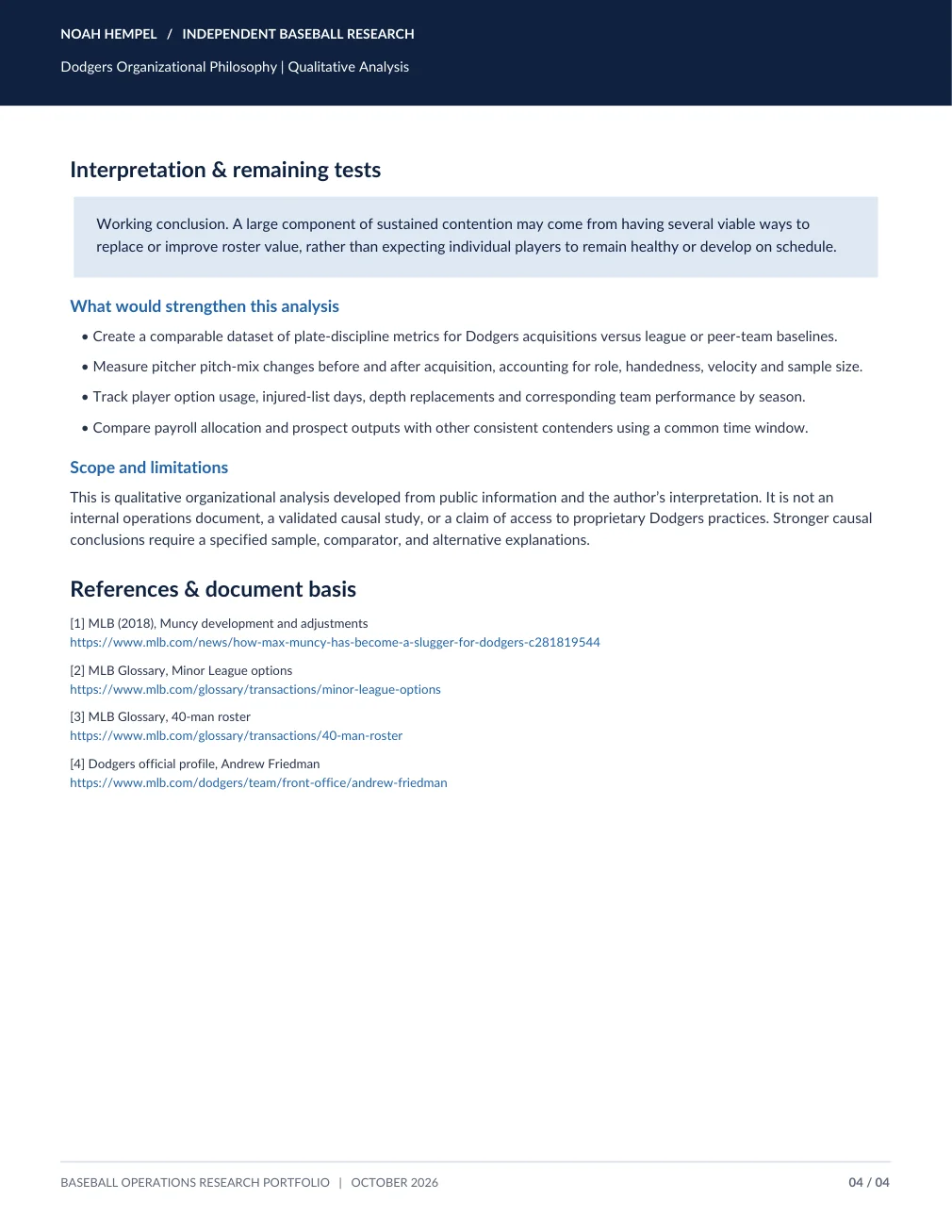
Interpretation & remaining tests
Working conclusion. A large component of sustained contention may come from having several viable ways to
replace or improve roster value, rather than expecting individual players to remain healthy or develop on schedule.
What would strengthen this analysis
• Create a comparable dataset of plate-discipline metrics for Dodgers acquisitions versus league or peer-team baselines.
• Measure pitcher pitch-mix changes before and after acquisition, accounting for role, handedness, velocity and sample size.
• Track player option usage, injured-list days, depth replacements and corresponding team performance by season.
• Compare payroll allocation and prospect outputs with other consistent contenders using a common time window.
Scope and limitations
This is qualitative organizational analysis developed from public information and the author’s interpretation. It is not an
internal operations document, a validated causal study, or a claim of access to proprietary Dodgers practices. Stronger causal
conclusions require a specified sample, comparator, and alternative explanations.
References & document basis
[1] MLB (2018), Muncy development and adjustments
https://www.mlb.com/news/how-max-muncy-has-become-a-slugger-for-dodgers-c281819544
[2] MLB Glossary, Minor League options
https://www.mlb.com/glossary/transactions/minor-league-options
[3] MLB Glossary, 40-man roster
https://www.mlb.com/glossary/transactions/40-man-roster
[4] Dodgers official profile, Andrew Friedman
https://www.mlb.com/dodgers/team/front-office/andrew-friedman
04 / 04